
IT Steering Committee Agenda Handbook: From Updates to Decisions
In my work as a Fractional CIO, I have walked into hundreds of boardrooms where the steering committee was nothing more than a status update session. The CEO checked their email, the CIO read slides, and nobody made a single decision. This is not governance; it is a waste of expensive salary hours. The steering committee should be the engine room of your IT strategy, not a spectator sport, and that transformation starts with a disciplined IT steering committee agenda. This handbook gives you the exact tools—charters, templates, and roles—to turn your next meeting into a high-performance decision engine.
Key Takeaways
- The IT Steering Committee exists to make business decisions, not to listen to status updates or product demos. If your meetings are consumed by slide walkthroughs, you are not governing.
- A clear Charter (Terms of Reference) must exist before you design any agenda. This document defines mandate, voting rights, and escalation paths—without it, your agenda is politics, not governance.
- The CEO or COO should chair the committee. The CIO and a Fractional CIO serve as strategic advisors and facilitators, not as meeting leaders.
- Follow the “80% decisions / 20% reporting” rule and translate it into a concrete 60–90 minute meeting structure where every agenda item is phrased as a decision.
- A disciplined IT Steering Committee Agenda sits at the center of an effective Information Technology Governance Framework that controls risk and budget across your entire technology portfolio.
Why Your IT Steering Committee Agenda Is Failing You
As a Fractional CIO who has sat in hundreds of steering committee meetings across industries, I can tell you with certainty that most organizations have broken their Information Technology Governance Framework at the most fundamental level: the agenda. The meeting agenda should be the steering wheel that directs your entire governance framework. Instead, I watch executives spend 60 minutes listening to status updates, 20 minutes watching software demos, and zero minutes making the decisions that actually control risk and budget.
The pattern is predictable and expensive. Project managers present slide after slide of progress metrics. Vendors walk through features nobody asked to see. The CFO checks email. The CEO glances at the clock. And when the hour ends, nothing has been decided. The failing CRM rollout continues. The cybersecurity investment gets deferred. The budget overrun goes unaddressed. These are not steering committee meetings—they are expensive, recurring rituals that consume executive time without producing governance.
This article is a practical handbook for CEOs, CFOs, and COOs who are tired of meetings that do not decide anything. I will walk you through the complete structure of an effective IT steering committee: Charter first, then roles and responsibilities, then a decision-centric agenda, and finally the operational cadence that makes governance repeatable. By the end, you will have a template you can implement in your next meeting.
Defining the IT Steering Committee’s Purpose Within Your Governance Framework

The steering committee is the business control tower for technology. It is not an IT department status meeting. It is not a project team update session. It is the forum where senior leadership makes trade-offs between risk, cost, and strategic value across all major IT and digital initiatives.
The purpose of your IT steering committee is to:
- Approve, pause, or terminate major technology investments based on business value and risk
- Allocate resources across competing initiatives when demand exceeds capacity
- Accept or reject material changes to scope, budget, and timeline that affect business outcomes
- Ensure that IT strategy remains aligned with business objectives and the organization’s strategic direction
- Provide governance oversight that protects the company from cyber risk, compliance failures, and project failure
Concrete examples of steering committee decisions:
- Approving a 2026 cybersecurity investment of $2.4M after reviewing threat assessments and regulatory requirements
- Deciding whether to continue or stop a failing CRM rollout that is 40% over budget with no clear path to value
- Prioritizing a data platform investment over a mobile app based on projected ROI and resource constraints
- Accepting a three-month delay to the ERP go-live to address critical integration risks
This committee sits under the board but above individual projects, forming a key component of your Information Technology Governance Framework for the next three to five years. If this purpose is not explicitly documented, the meeting agenda will be hijacked by status reporting and “show and tell” demonstrations. Every steering committee meeting will drift toward the path of least resistance: updates instead of decisions.
IT Steering Committee Charter: The Non-Negotiable Foundation
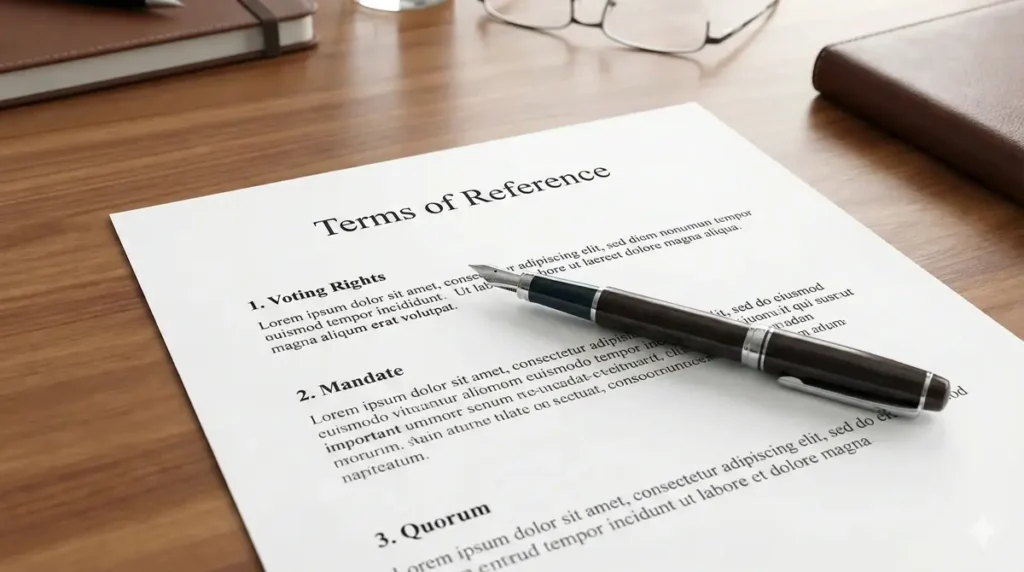
Without a written Charter—also called Terms of Reference—any agenda is politics, not governance. I have seen organizations spend months debating decisions that should take ten minutes, simply because nobody documented who has the authority to decide.
The steering committee charter is a three-to-five page document approved once by the executive team and revisited annually, typically each January. It is not a bureaucratic exercise. It is the foundation that makes every subsequent meeting productive.
Essential Charter elements:
- Mandate and scope: What is in scope (major IT investments, digital transformation, cybersecurity strategy) and what is out of scope (day-to-day operations, minor procurement)
- Decision rights: Which decisions the committee can make unilaterally versus which require board escalation
- Voting rules: Simple majority, unanimous consent, or chair’s casting vote in case of deadlock
- Cadence: Monthly, quarterly, or as-needed, with clear expectations for attendance
- Relationship to the board and audit committee: How findings and decisions are reported up
- Escalation procedures: What happens when a decision cannot be reached or when risks exceed defined thresholds
Critical requirement: The Charter must define which decisions cannot leave the room undecided. For example:
- Budget overruns above 10% must be approved or rejected before the meeting ends
- Scope changes impacting go-live dates require a firm decision
- Acceptance of new cyber risks must be formally documented with an accountable owner
The Charter should explicitly anchor the “80% Decision Making / 20% Reporting” golden rule so that agendas and minutes are aligned with it. When committee members see this ratio in the Charter, they arrive expecting to make decisions, not to listen to presentations.
Roles and Responsibilities: Who Sits at the Table and Who Leads It
Membership is a business decision, not an IT social club. Seats on the steering committee are tied to accountability for P&L and risk. If someone does not own budget, benefits, or risk, they should not be a voting member.
Why the CEO or COO should chair—not the CIO:
- The CIO has an inherent conflict of interest: they are both requesting resources and being held accountable for delivery
- Budget ownership and business authority must sit with the chair to drive successful outcomes
- The steering committee is a business governance forum, not a technology review session
- When the CEO or COO chairs, the implicit message is clear: technology decisions are business decisions
Core steering committee members:
| Role | Responsibility |
|---|---|
| CEO or COO (Chair) | Runs the meeting, enforces decisions, represents enterprise interests |
| CIO or Head of Technology | Presents options, risks, and recommendations; accountable for delivery |
| CFO | Validates financial implications, approves budget changes |
| 2–4 Business Unit Leaders | Own benefits realization, represent business functions |
| CISO or Risk Representative | Advises on security and compliance risks |
| Fractional CIO (where appropriate) | Facilitates, prepares pre-reads, translates technology into business trade-offs |
Role expectations must be explicit:
- The chair runs the meeting and enforces the decision making process. If a decision is on the agenda, it gets made.
- The CIO presents options and risks. They do not chair, and they do not vote on their own proposals.
- The CFO validates financial implications and provides support for budget discipline.
- Business leaders own benefits realization. They are accountable for ensuring that approved projects deliver the promised value.
- High level stakeholders attend to make informed decisions, not to observe.
The Fractional CIO’s role:
As a Fractional CIO, I serve as translator and agenda architect. I prepare pre-reads that frame decisions clearly. I coach project managers to bring decision-ready items. I ensure that technology language is converted into business trade-offs. I brief the CEO or COO before each meeting so they can provide guidance without getting lost in technical details. This role protects senior management from being dragged into low-level debates while still giving them firm control of risk, budget, and delivery priorities.
The Golden Rule: 80% Decision Making, 20% Reporting
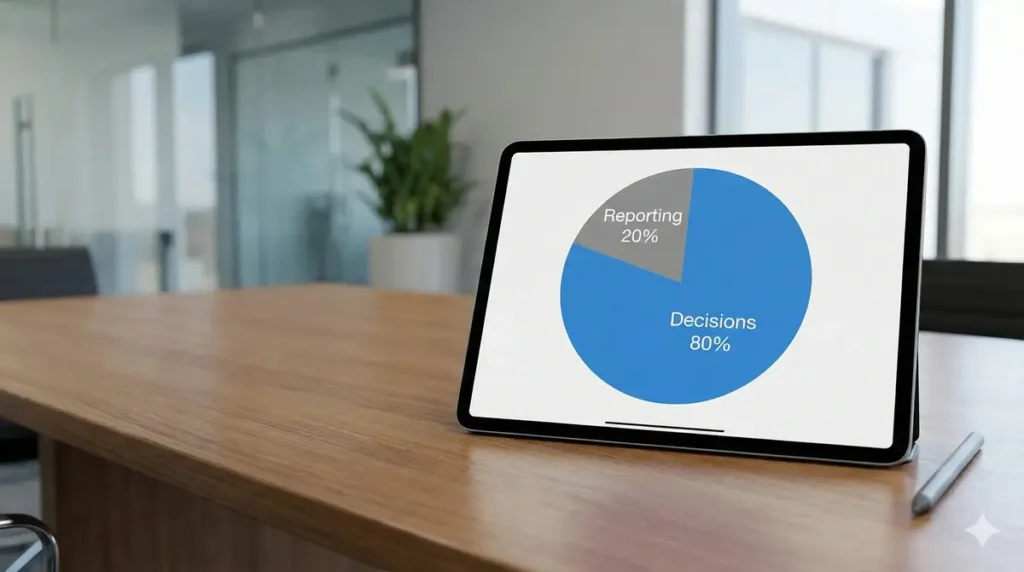
If your steering committee spends more than 20% of its time on status reporting, you are burning executive time and not governing. This is not an opinion. It is the fundamental principle that separates effective IT steering committees from expensive talk shops.
How to implement the 80/20 rule:
- Routine status should be delivered via a concise, two-to-three page dashboard emailed 48 hours before the meeting. Senior managers review it before they arrive.
- Only exceptions, risks, and items requiring decisions may be elevated from the status dashboard onto the live agenda.
- Project teams prepare decision briefs, not progress reports. If there is no decision to be made, there is no agenda slot.
This golden rule changes behavior throughout the organization:
- Project managers come seeking decisions, not applause. They know their time in front of the committee is for resolving conflicts, approving changes, or accepting risks.
- Executives come ready to trade off scope, budget, and time. They have reviewed the pre-reads and arrive with questions, not discovery.
- Senior stakeholders stop viewing the meeting as an informational session and start treating it as the decision making forum it should be.
Warning: The “Show and Tell” Trap
Disallow live demos unless a specific decision depends on seeing them. If you are selecting between two CRM vendors by June 30, 2026, a brief demo of both may be appropriate. If you are six months from any vendor decision, the demo does not belong in the steering committee meeting.
Industry studies show that ineffective committees spend 50-70% of meeting time on demos and walkthroughs. This is time that should be spent on decisions about risk management, resource allocation, and strategic direction.
Designing an Effective IT Steering Committee Agenda
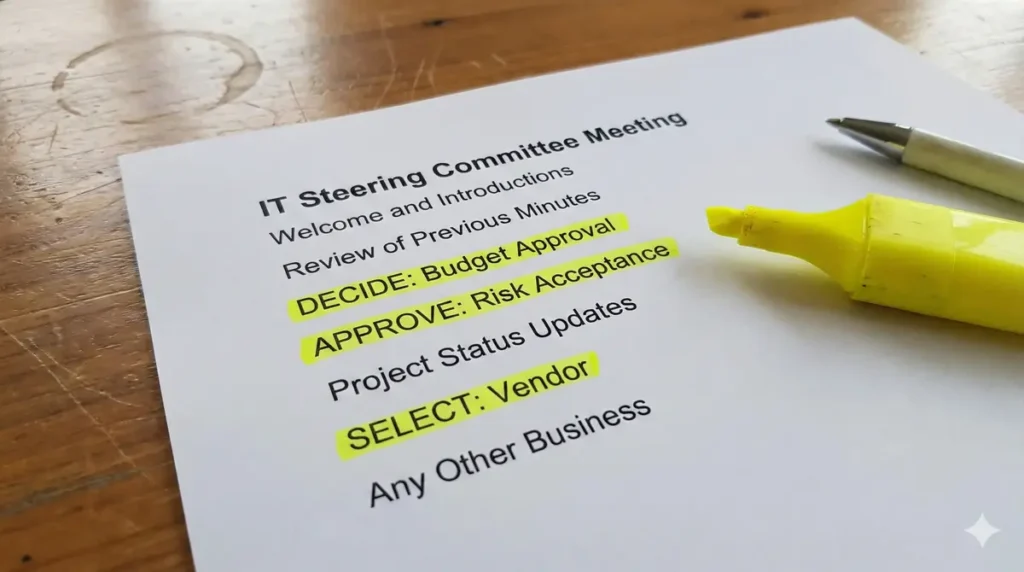
The meeting agenda is a decision-making tool, not a calendar filler. It must be circulated at least three working days before the meeting, ideally with seven to ten days for complex decisions.
Structural requirements:
- Standard meeting length: 60 or 90 minutes, depending on portfolio complexity
- Every agenda item is phrased as a decision or outcome, not an activity
- “Decide X” instead of “Discuss X”
- “Approve Y” instead of “Review Y”
Example agenda items phrased as decisions:
- Approve revised 2025 ERP budget increase of 12% ($340K) to address integration scope gap
- Decide whether to stop the legacy data center migration in Q3 2026 and accept extended support costs
- Accept the recommendation to select Vendor A for cloud security monitoring (investment: $180K annually)
- Approve six-week delay to CRM Phase 2 go-live to address data quality issues
- Decide on 2026 cybersecurity investment priorities: endpoint detection vs. identity management
- Terminate the mobile app pilot project and reallocate $120K to customer portal enhancements
Each agenda item must include:
- An owner who is responsible for presenting and recommending
- A clear timebox (e.g., 10 minutes)
- A one-sentence objective stating what decision is required
- A specific pre-read reference (e.g., “See page 4 of the dashboard” or “Decision Brief A attached”)
The chair or Fractional CIO has authority to remove items that are not decision-ready. If a proposal arrives without options, impact analysis, or a clear recommendation, it does not belong on the agenda. Send it back to the project team with clear guidance on what is needed.
Sample IT Steering Committee Agenda Structure (60–90 Minutes)
This is a concrete template CEOs and COOs can adopt for their next steering committee meeting. Copy it into your calendar invite and adapt it to your portfolio.
60-Minute Structure (Standard Portfolio)
| Time | Block | Purpose |
|---|---|---|
| 0–5 min | Opening | Confirm quorum, approve prior minutes, review open action items |
| 5–15 min | Risk and Health Dashboard | Review exceptions only; no reading of status already in pre-read |
| 15–50 min | Decision Blocks (3–4 items) | Each item: 8–10 minutes for presentation, discussion, and decision |
| 50–60 min | Closing | Confirm decisions made, assign action items with owners and deadlines, identify items for next agenda |
90-Minute Structure (Complex Transformation Portfolio)
| Time | Block | Purpose |
|---|---|---|
| 0–5 min | Opening | Confirm quorum, approve prior minutes, review open action items |
| 5–20 min | Health and Risk Review | Dashboard review, escalated risks, compliance updates |
| 20–80 min | Decision Blocks (5–6 items) | Each item: 10–12 minutes for presentation, discussion, and decision |
| 80–90 min | Forward Look and Closing | Preview next meeting decisions, board reporting needs, confirm action items |
Notice that in both structures, no more than 15–20 minutes total are spent on pure reporting. The remaining time is devoted to making important decisions that affect project outcomes and business objectives.
Keeping the Agenda Out of the “Show and Tell” Trap
I have watched entire steering committee meetings consumed by vendor demos and slide walkthroughs that never surface a single decision. This is one of the most common ways organizations waste executive time and undermine their steering committee structure.
The firm rule: No demo appears on the agenda unless a specific decision depends on seeing it.
Acceptable demo scenarios:
- Choosing between two CRM vendors by a defined date, with a decision on the agenda
- Go/no-go decision for production release, where the demo demonstrates readiness
- Board presentation preview, where executives need to approve the content
How to handle demos outside the steering committee:
- Schedule separate working sessions for deep dives, inviting only the committee members who need to attend
- Record demos and circulate them as pre-reads with a summary brief
- Include summary screenshots or key visuals in the pre-read pack, not in the live meeting
The steering committee should see concise visuals that frame issues and options. Industry experts agree: subject matter experts and project teams should prepare materials that answer “What decision do you need from us?” not “Let me show you what we built.”
The chair must actively intervene if the discussion drifts into feature-level debates. When I facilitate steering committees, I use a simple phrase: “Let’s table the feature discussion and focus on the decision. What do we need to resolve today?” This saves time and keeps the agenda on track toward continuous improvement in governance discipline.
Operational Cadence: Frequency, Pre-Reads, and Minutes
Recommended cadence:
- Monthly during active transformation programs (ERP implementations, cloud migrations, digital transformation)
- Quarterly once the portfolio stabilizes and projects are in steady-state delivery
- Ad-hoc meetings only for urgent risk decisions that cannot wait for the regular cadence
Many organizations default to monthly, which provides enough time between meetings to make meaningful progress while maintaining governance oversight.
Pre-read requirements:
- Circulate packs and dashboards at least 72 hours in advance
- Include a clear cover page highlighting the three to five decisions requested
- Keep the core pack concise: one-page executive summary, portfolio dashboard with health indicators, and one to two pages per major initiative showing options and recommendations
- Place raw project plans, technical diagrams, and vendor materials in annexes for reference only
Pre-reads must be brief enough time for executives to review in 20–30 minutes. If committee members cannot read the materials before the meeting, they arrive unprepared to make informed decisions.
Minutes standards:
- Document decisions made, owners assigned, and due dates committed
- Avoid narrative transcripts—minutes are a record of commitments, not a meeting summary
- Distribute minutes within 48 hours
- Use prior meeting minutes as the first agenda item to close the loop on commitments
This simple discipline forms a repeatable rhythm essential to a mature Information Technology Governance Framework. It also creates audit-ready documentation that demonstrates governance to board members, regulators, and auditors.
The Fractional CIO Advantage in Steering Committee Meetings

As a Fractional CIO, I sit between business and IT, turning technical noise into clear options and recommendations. This is not a theoretical position—it is the practical reality of how I add value to steering committee work.
What a Fractional CIO brings to your steering committee:
- Design the Charter so that mandate, voting rights, and decision processes are explicit from day one
- Construct the decision-centric agenda that enforces the 80/20 rule
- Coach project managers to bring decision-ready items with options, impact analysis, and recommendations
- Brief the CEO or COO before each meeting so they can chair with confidence
- Translate technical language into business trade-offs that executives can evaluate
- Facilitate discussions to resolve conflicts and keep the agenda moving toward decisions
Example scenarios where a Fractional CIO transforms steering committee effectiveness:
- Stalled ERP program: The project team presents monthly updates with no decisions. I restructure the agenda to force a go/no-go decision on each phase, with clear criteria and consequences. Within two meetings, the committee decides to descope Phase 3 and accelerate Phase 2, saving $400K.
- Spiraling cloud spend: Cloud costs have grown 35% year-over-year with no governance. I introduce a quarterly cloud investment review as a standing agenda item, requiring the CIO to present optimization options. The committee approves a consolidation initiative that reduces spend by 18%.
- Fragmented cybersecurity investments: Three different business units are requesting separate security tools. I prepare a consolidated brief showing overlap and gaps, framing a decision between unified platform investment versus continued fragmentation. The committee chooses the platform approach, improving security posture and reducing vendor complexity.
For midsized organizations that cannot justify a full-time CIO, a Fractional CIO provides enterprise-grade governance discipline at a fraction of the cost. You get board-level experience driving your Information Technology Governance Framework without the overhead of a permanent executive hire.
Conclusion: Stop Wasting Time in Meetings That Don’t Decide Anything
An effective IT Steering Committee is not about scheduling a recurring meeting; it is about installing a discipline. When you enforce the Charter, respect the Agenda, and demand decisions, you transform IT from a “black box” of costs into a transparent driver of value.
When the agenda is treated as a decision-making instrument, IT becomes governable. Budgets are predictable because overruns are caught and addressed in real time. Project success rates improve because failing initiatives are stopped or restructured before they consume more resources. Cyber risk is addressed proactively because security investments compete fairly with other priorities in a structured decision making process.
Stop wasting time in meetings that do not decide anything. Start governing.
Is Your Steering Committee Stuck in “Show and Tell” Mode?
Frequently Asked Questions
1. How often should an IT Steering Committee meet to remain effective?
Most organizations benefit from monthly meetings during active transformation programs—ERP implementations, cloud migrations, or major digital initiatives. Once the portfolio stabilizes into steady-state delivery, quarterly meetings typically suffice.
The right cadence reflects decision velocity: if key initiatives require frequent trade-offs on scope, budget, or risk, monthly is essential. I advise against weekly steering meetings, which tend to drift into operational status reviews rather than strategic governance. Weekly cadence also makes it difficult to prepare quality pre-reads and decision briefs, reducing the committee’s effectiveness.
2. What size is ideal for an IT Steering Committee?
A practical size is six to nine voting members. This balance provides diversity of perspective across business functions while maintaining the ability to make timely decisions. Additional subject matter experts, project managers, or industry experts can attend by invitation for specific agenda items, but they should not all be standing members. Once the group exceeds about ten active voices, the chair will struggle to keep the agenda focused on decisions instead of broad debate. Larger groups also create scheduling challenges that lead to delayed or cancelled meetings—undermining the governance rhythm entirely.
3. How do we handle disagreements when the committee cannot reach consensus?
The Charter should explicitly state how decisions are made when consensus is not achieved. Common approaches include simple majority vote, chair’s casting vote in case of tie, or escalation to the board for decisions above a defined threshold. I encourage the chair to prioritize what is in the best interests of the organization as a whole, not just individual departments, and to make a firm call when needed. Unresolved issues should be timeboxed—if a decision cannot be made within the allocated agenda time, it escalates to the board or a dedicated risk committee rather than allowing it to derail the entire meeting.
4. What information should be in the pre-read pack for each meeting?
The pre-read pack should include a one-page executive summary listing the required decisions, a portfolio dashboard with health and risk indicators, and one to two pages per major initiative showing options and recommendations.
Avoid including raw project plans, detailed technical diagrams, or vendor slide decks in the core pack—these belong in annexes that members can access if needed. The goal is a pack concise enough for executives to review in 20–30 minutes. When committee members arrive having reviewed the materials, they can engage immediately in decision making rather than discovering the content in real time.
5. How do we measure whether our IT Steering Committee Agenda is working?
Track a small set of metrics focused on decision effectiveness: percentage of agenda items that result in a clear decision, average time-to-decision for major issues, and the number of unplanned escalations outside the committee.
Review, at least annually, whether the committee’s decisions have reduced project overruns, improved benefit realization, and lowered material IT risk incidents. I also recommend a short, anonymous annual survey asking members if meetings are decision-oriented, well-prepared, and worth the executive time invested. If scores decline or decision velocity slows, revisit the Charter and agenda structure to identify where discipline has slipped.