
Sourcing Top Talent: Navigating the Best Programming Languages for AI in 2026
In my years as a CIO and IT consultant, I have witnessed numerous AI initiatives stall—not because of a lack of funding or vision, but because of a mismatch in technical talent. When executives ask me to audit a failing project, I often find that the team was built for one purpose (e.g., web development) but tasked with another (e.g., high-frequency trading algorithms). The root cause usually traces back to a misunderstanding of the fundamental programming languages for AI. Among the most popular programming languages for AI, Python stands out due to its widespread use, extensive libraries, and strong community support, making it a top choice for AI and data science projects.
Selecting the right talent isn’t just about finding someone who can “code.” It is about understanding that the choice of language dictates the speed, scalability, and maintainability of your artificial intelligence strategy. If you hire a team of R-specialists to build a production-grade chatbot, you will fail. If you hire C++ engineers to prototype a simple data model, you will burn through your budget before you launch.
This guide is designed for the hiring manager, the CTO, and the Board Member. It breaks down the critical programming languages for AI through the lens of resourcing: who you need to hire, what skills to look for on their CV, and how to align their expertise with your business goals.
Key Takeaways for Hiring Managers
- Strategy First: Don’t hire for syntax; hire for the outcome. Python is for speed; C++ is for performance; R is for research.
- The “Hybrid” Reality: Most enterprise AI stacks require a mix of languages (e.g., Python for the model, Java for the integration).
- Talent Scarcity: Senior developers with architectural experience in programming languages for AI are rare locally. Global sourcing is often the only viable route to scalability.
- Governance Matters: Ensure your team understands not just the code, but the compliance and security implications of the models they build.
The Strategic Importance of Programming Languages for AI
Why should a non-technical executive care about syntax? Because in the world of Artificial Intelligence, the language defines the ecosystem. Selecting from the top AI programming languages, such as Python and Julia, is strategically important as it can impact both the capabilities of your AI systems and your ability to attract top talent.
When we talk about sourcing talent for programming languages for AI, we are effectively discussing the trade-off between Time-to-Market and System Performance.
- Rapid Prototyping: Languages like Python allow for fast iteration but may struggle at a massive scale.
- High Performance: Languages like C++ run close to the hardware, offering blazing speed but requiring longer development cycles.
- Statistical Research: Languages like R are unbeatable for analysis but poor for product deployment.
Your resourcing strategy must match your product lifecycle. Are you in the R&D phase, or are you deploying to millions of edge devices? The answer determines the profile of the candidate you need to source.
AI Programming Fundamentals: A Resourcing Perspective
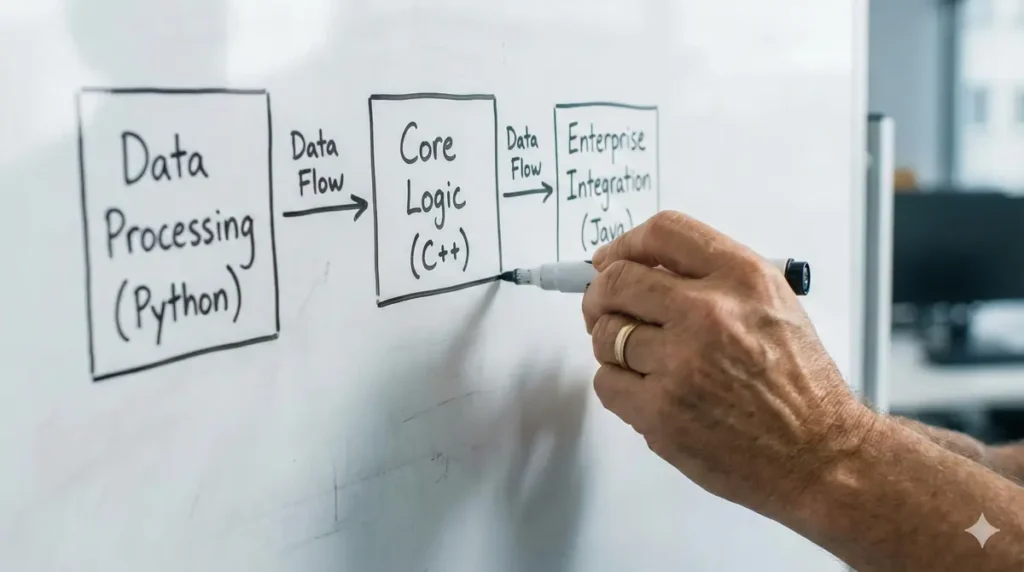
AI programming fundamentals form the backbone of modern artificial intelligence development, but for the hiring manager, “fundamentals” does not mean coding syntax—it means architectural competence. At its core, AI programming is about leveraging the right programming languages for AI—such as Python, Java, and C++—to design systems that are not just intelligent, but scalable and governable.
When vetting candidates, look for those who understand Object-Oriented Programming (OOP) not just as a coding style, but as a way to build modular, reusable business assets. This approach is especially valuable in complex AI projects, where teams must frequently update models or adapt to evolving data compliance regulations (like GDPR).
Machine learning algorithms are at the heart of AI development. These algorithms—ranging from supervised learning to deep learning—allow AI systems to automate decision-making. However, the best developers don’t just “know” these algorithms; they know which programming languages for AI unlock the best libraries (such as scikit-learn or TensorFlow) to implement them efficiently.
Effective data processing ensures that your AI systems can handle big data and distributed processing, all of which are essential for high-performance AI applications. Whether you are hiring computer vision engineers for a retail project or NLP specialists for a customer service bot, the foundational choice of language will dictate your long-term technical debt.
Mastering these fundamentals empowers your leadership team to select the right programming languages for AI that drive genuine business value, rather than just chasing the latest tech trends.
1. Python: The King of Rapid Development
When analyzing the landscape of programming languages for AI, Python is the undisputed market leader. According to the 2024 GitHub Octoverse Report, Python has overtaken JavaScript as the most popular language on GitHub, largely driven by the boom in Generative AI. It is the lingua franca of modern data science. Python’s extensive ecosystem of libraries and frameworks makes it especially powerful for building and deploying AI models across various platforms. However, its ubiquity makes hiring tricky—the market is flooded with junior developers who know Python syntax but lack AI architectural skills.
The Business Case for Python
If your goal is Generative AI, Natural Language Processing (NLP), or Rapid Prototyping, you need Python experts. It creates the shortest path from “Idea” to “MVP” (Minimum Viable Product).
What to Look for in a Candidate
Don’t just look for “Python” on the resume. A top-tier Python AI candidate is often a Machine Learning Engineer. To filter for top-tier AI talent, look for proficiency in these specific libraries:
- TensorFlow & PyTorch: The standard frameworks for deep learning.
- Scikit-learn: Essential for traditional machine learning algorithms.
- Pandas & NumPy: Critical for data manipulation.
Resourcing Tip: A senior Python AI developer should understand deployment. Ask them how they move a model from a Jupyter Notebook to a production API using tools like Docker or FastAPI.
2. C++: The Engine for High-Performance Computing
While Python is easy to write, it can be slow to execute. This is where C++ enters the conversation of programming languages for AI. C++ is often used in scenarios where milliseconds matter—such as autonomous vehicles, high-frequency trading, and gaming engines.
The Business Case for C++
If you are building Edge AI (AI that lives on a device, like a drone or a smart camera) or a system that processes massive real-time data streams, you cannot rely solely on Python. You need the raw speed of C++. As noted by NVIDIA’s Developer Blog, maximizing GPU performance often requires deep C++ and CUDA expertise that goes beyond standard coding skills.
What to Look for in a Candidate
C++ developers are harder to source and typically command higher rates than Python developers.
- Memory Management: Unlike Python, C++ requires manual memory handling. A skilled candidate must demonstrate expertise in preventing memory leaks.
- CUDA: If they are working with NVIDIA GPUs (common in AI), experience with CUDA is a massive plus.
- Embedded Systems: Look for experience deploying code to hardware, not just cloud servers.
3. Java: The Enterprise Standard
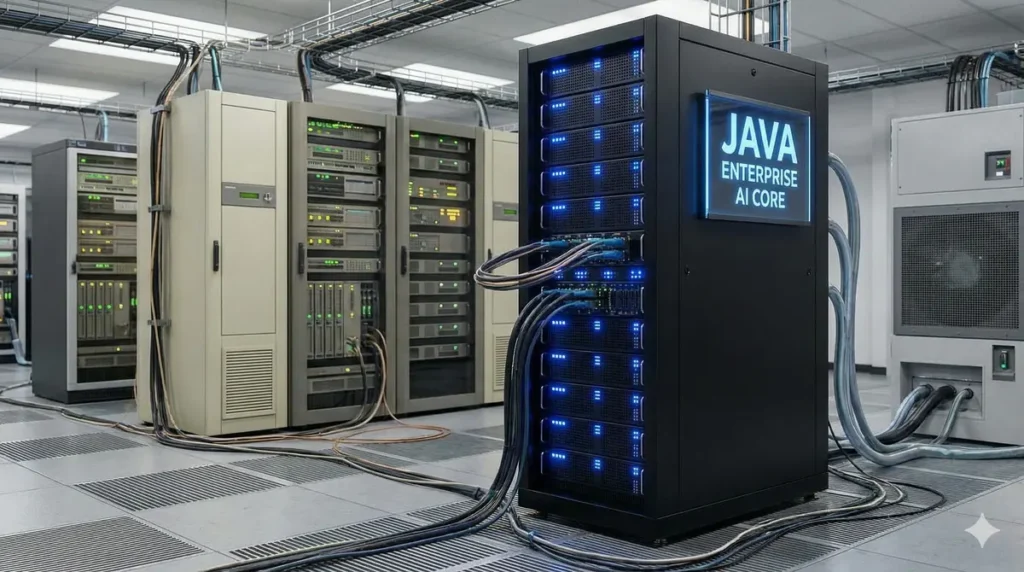
Java is rarely the first name mentioned in cool startups, but it remains a titan in the Fortune 500. When discussing programming languages for AI in the context of banking, insurance, and large-scale enterprise systems, Java is vital.
The Business Case for Java
If your organization already runs on a massive Java infrastructure (common in financial services), it is often easier to integrate AI using Java than to introduce a new language stack. Java offers seamless integration and robust security features that IT Directors love. Oracle’s AI Strategy emphasizes that for large enterprises, integrating AI agents directly into existing Java workflows reduces complexity and security risks.
What to Look for in a Candidate
- Deeplearning4j: An open-source, distributed deep-learning library created for the JVM (Java Virtual Machine).
- Scalability: Java developers should be experts in building systems that don’t crash under load.
Resourcing Tip: Hire Java AI experts when you are “adding AI” to an existing legacy application, rather than building a new AI product from scratch.
4. R: The Statistician’s Tool
R is unique among programming languages for AI. It was built by statisticians, for statisticians. It excels in heavy statistical analysis and data visualization but is rarely used for deploying consumer-facing applications. The R Project for Statistical Computing remains the gold standard for pure data analysis in academia and research sectors.
The Business Case for R
R is the language of Bioinformatics, Clinical Research, and Financial Modeling. If your “AI” project is actually a deep statistical research project (e.g., drug discovery or economic forecasting), R is superior to Python.
What to Look for in a Candidate
- Academic Background: R specialists often hold PhDs or advanced degrees in mathematics or statistics.
- Visualization: Look for expertise in ggplot2—the gold standard for data visualization.
Resourcing Tip: Do not hire an R developer to build your web backend. Hire them to find the insights, then hand those insights to a software engineer to productionize.
5. Julia: The Rising Star
Julia is the newcomer in the list of programming languages for AI. As a relatively new language designed for high-performance scientific and AI computing, it attempts to solve the “two-language problem”—it is as easy to write as Python but as fast as C++.
The Business Case for Julia
Julia is increasingly used in scientific computing and high-performance numerical analysis. While the talent pool is small, it is passionate and highly skilled. Adopting Julia can give you a performance edge in computationally heavy lifting without the overhead of C++.
Quick Decision Guide: Matching Language to Project
| If your priority is… | You need expertise in… | Best for… |
| Speed to Market | Python | MVP development, Generative AI, NLP. |
| System Performance | C++ | Real-time trading, Autonomous systems, Edge AI. |
| Enterprise Stability | Java | Banking systems, Large-scale backend integration. |
| Statistical Depth | R | Bio-tech, Economic forecasting, Deep research. |
| Scientific Computing | Julia | High-performance numerical analysis. |
Strategic Resourcing: Matching the Language to the Goal
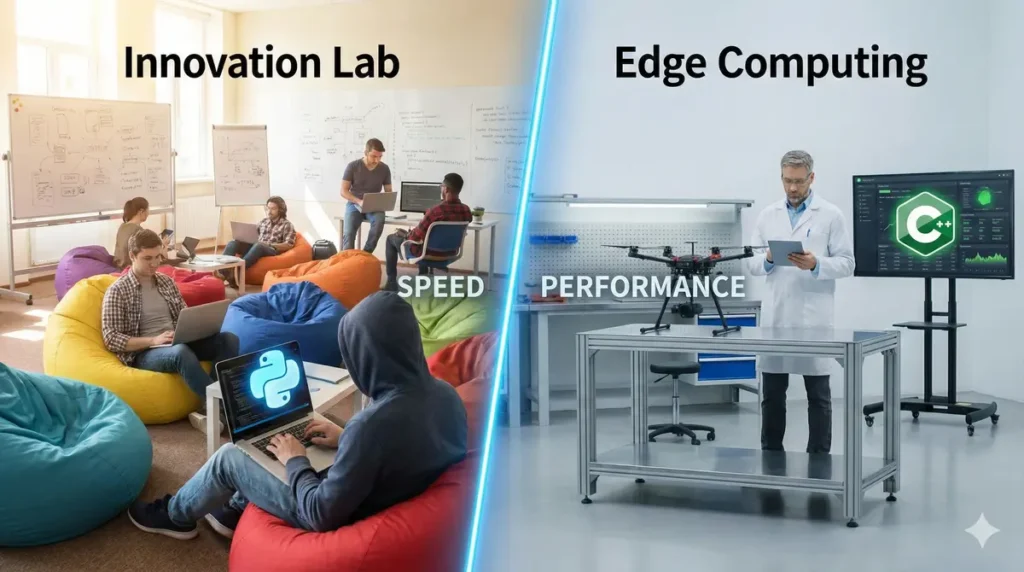
The most common mistake I see in my consulting practice is the “One Size Fits All” approach. Executives hear that “AI is Python,” so they force their engineering teams to use Python for high-performance embedded systems, resulting in sluggish products.
To build a world-class AI capability, you must move beyond the buzzwords and understand the specific utility of different programming languages for AI.
- For the Innovation Lab: Hire Python experts to test ideas fast.
- For the Core Engine: Hire C++ engineers to optimize performance.
- For the Research Division: Hire R statisticians to prove the math.
- For the Enterprise Platform: Hire Java developers to ensure stability.
Conclusion: The “Global Talent” Solution
The challenge for 2026 is not just knowing which languages you need—it is finding the people who speak them. The local talent pool for specialized skills like C++ for Edge AI or Julia for Scientific Computing is often dry or prohibitively expensive.
At Blue Phakwe, we understand that a successful AI strategy requires a diverse technical stack. We specialize in Global Strategic Resourcing, helping you source and vet top-tier developers across all major programming languages for AI. Whether you need a remote team of Python data scientists or a niche C++ optimization engineer, we bridge the gap between your strategic vision and technical execution.
Ready to build your high-performance AI team?
Contact Blue Phakwe today to discuss your technical staffing needs and let us help you find the perfect fit for your stack.
Frequently Asked Questions
1. Which programming languages for AI are best for beginners?
For beginners and rapid prototyping, Python is the best choice. Its simple syntax and vast library ecosystem (like TensorFlow and PyTorch) make it the most accessible entry point into Artificial Intelligence.
2. Is C++ better than Python for AI?
It depends on the use case. Python is better for development speed, data analysis, and model training. C++ is better for deployment, execution speed, and resource-constrained environments like embedded devices. Most advanced AI teams use both.
3. Do I need to hire separate developers for different programming languages for AI?
Often, yes. While “Full Stack” developers exist, AI is complex. It is common to have Data Scientists who work in Python/R to create models, and Machine Learning Engineers who work in C++/Java to deploy those models into production systems.
4. Why is R still used if Python is so popular?
R remains the industry standard for specialized fields like bio-statistics, econometrics, and heavy academia. If your AI project requires rigorous statistical validation rather than just predictive capability, R is often the superior tool.