
Agentic AI Strategy Roadmap: Solving the Budget Paradox for Mid-Sized Enterprises
As a former Group CIO with over 20 years in the seat, I have seen many technology hype cycles come and go. However, the most critical challenge for leadership in 2026 is defining a clear Agentic AI strategy. While your Board has likely spent the last two years asking about “Generative AI” tools that create content, the executive agenda is now shifting to autonomous systems that execute work. This transition represents a massive leap in operational efficiency, but it requires a strategic approach that balances innovation with flat IT budgets.
This guide is designed for CIOs, IT leaders, and executives at mid-sized enterprises seeking to implement agentic AI strategies. Understanding how to deploy agentic AI effectively is critical for maintaining competitiveness as budgets tighten and automation accelerates.
The Strategic Importance of Agentic AI in Modern Enterprises
The rise of agentic AI represents a strategic inflection point that will redefine how companies operate, compete, and create value. Developing an agentic AI strategy is now essential for organizations seeking a competitive advantage in the agentic era. Agentic AI requires organizations to fundamentally rethink their operating models, with 78% of executives agreeing that achieving maximum benefit from agentic AI requires a new operating model. By 2027, 67% of executives expect AI agents to take independent action in their organizations, underscoring the urgency of ai transformation to stay ahead.
This transition from chatbots that “write emails” to autonomous agents that “manage the entire customer refund process” represents a massive leap in operational efficiency. But for most mid-sized enterprises, this opportunity comes with a significant hurdle: the Budget Paradox.
What is the Budget Paradox?
The Budget Paradox is the defining challenge for 2026: IT budgets are flat, yet the pressure to deploy these autonomous agents is exploding.
Mid-sized organizations are stuck in a difficult position. You cannot hire a massive internal AI R&D team to solve this challenge—the talent is too scarce and too expensive. Yet, if you remain stuck in “Analysis Paralysis,” your cost structures will become uncompetitive against rivals who figure out how to deploy safe, autonomous labor.
Successful agent deployment often focuses on specific, well-defined domains rather than attempting enterprise-wide automation. To maximize value from AI agents, organizations must rethink business processes and enable deep integration with enterprise systems. However, integrating agentic AI can be challenging due to the need to replace or modernize legacy systems that may not support seamless communication or automation.
You do not need a $50 million budget to start. You need a smarter operating model. Here is how nimble enterprises are solving this paradox.
Understanding Agentic AI
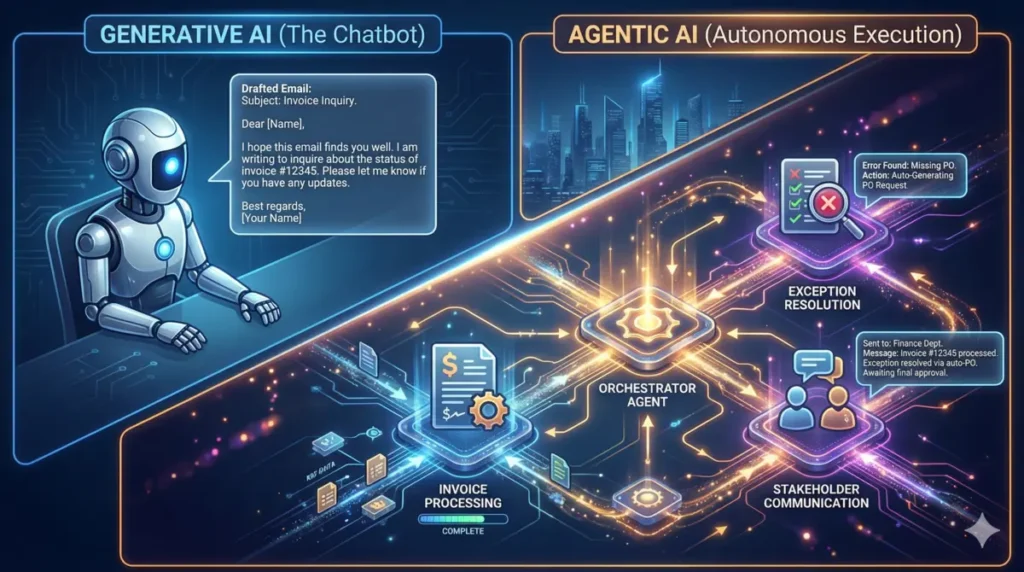
Agentic AI is ushering in a new paradigm for how organizations operate. At its core, agentic AI refers to artificial intelligence systems that can act autonomously—making decisions and executing tasks across business processes with minimal human intervention. AWS provides a detailed breakdown of the agentic AI life cycle stages, explaining how these systems perceive, reason, act, and learn to manage complex workflows effectively.
Agentic AI systems are capable of understanding goals, breaking them into subtasks, interacting with both humans and systems, executing actions, and adapting in real time.
Unlike traditional AI models, which typically require explicit instructions or operate within narrow, pre-defined parameters, agentic AI systems are designed to learn, reason, and adapt in real time. For a deeper dive into how agentic AI is transforming enterprise workflows, see Deloitte’s insights on agentic AI.
This means that agentic AI can navigate complex workflows, respond to changing conditions, and optimize outcomes on the fly. For example, instead of simply flagging an invoice for review, an agentic AI system can manage the entire approval process, resolve exceptions, and communicate with stakeholders—all without waiting for a human to step in.
The real power of agentic AI lies in its ability to drive operational efficiency and deliver measurable business outcomes. By embedding these intelligent systems into existing business processes, organizations can automate decision-making, reduce manual effort, and unlock new levels of productivity. As enterprises look to stay competitive, agentic AI represents a significant leap forward from traditional AI, enabling smarter, faster, and more adaptive business operations.
Agentic AI systems leverage enterprise data—both structured and unstructured data—to fuel their decision-making processes. Through machine learning and advanced AI technologies, these systems continuously improve via feedback loops, evolving their capabilities to handle increasingly complex tasks and adapt to dynamic environments.
A 5-Step Agentic AI Strategy to Solve the Budget Paradox
To navigate the Budget Paradox, mid-sized enterprises must abandon the traditional heavy-lift IT models of the past. You do not need a massive R&D budget; you need a smarter operating model. We have developed a pragmatic, five-step Agentic AI strategy designed specifically to help you deploy autonomous agents safely, cost-effectively, and rapidly.
1. Stop the Bleeding: The Fractional CIO Model
The traditional approach to IT leadership—hiring full-time, high-cost executives for every role—is often inefficient for this phase of transformation. Smaller and mid-sized organizations often lack dedicated AI leadership to navigate these complexities.
This is where the Fractional CIO advantage comes into play. Instead of bearing the full load of a permanent executive, organizations can leverage fractional leadership to:
- Audit current IT spend: We review existing contracts and infrastructure to redirect waste toward innovation.
- Design AI roadmaps: We build strategic plans aligned strictly with business strategy, ensuring you don’t chase technology for technology’s sake.
- Evaluate platforms objectively: A fractional leader helps you select tools without vendor bias, navigating the complex landscape of “Build vs. Buy” decisions.
- Provide executive-level guidance: You gain Director-level insight at a fraction of the full-time cost.
Organizations must structure small, multidisciplinary teams to manage AI agents and focus on end-to-end outcomes. It is also essential to establish control mechanisms and governance frameworks to manage the risks and costs associated with agentic AI.
By utilizing a fractional model, you free up the capital required to fund the actual implementation of Agentic AI.
2. Source Smart: Global Strategic Resourcing
Once you have the strategy in place, how do you build the technology without blowing the budget? The answer lies in Global Strategic Resourcing.
Many organizations make the mistake of trying to hire scarce AI talent locally. This often leads to bidding wars you cannot win. A more effective strategy is to partner with international resource pools.
Leading organizations are proactively addressing workforce adaptation and new role development as they implement agentic AI strategies.
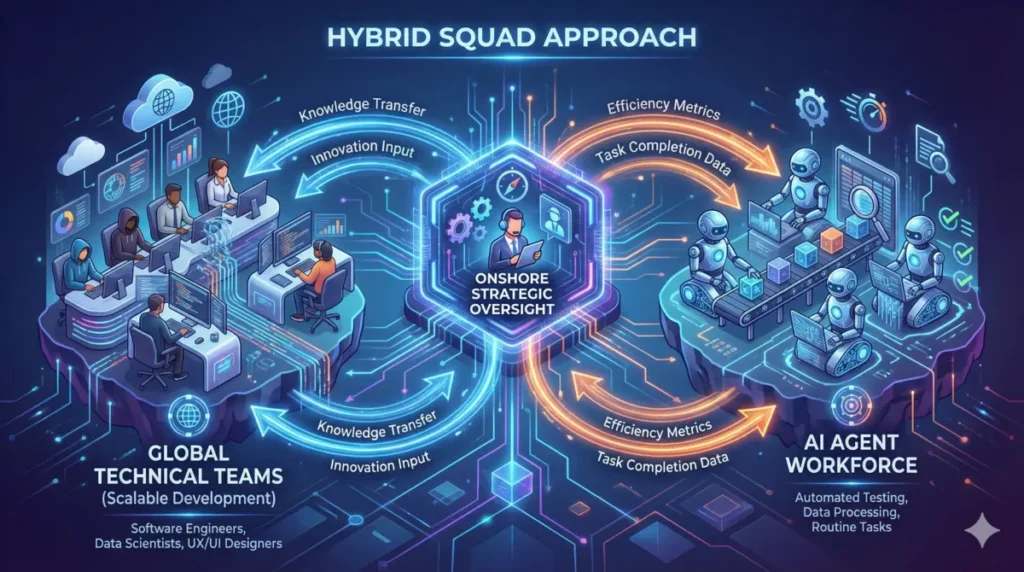
At Blue Phakwe, we advocate for a hybrid sourcing model that balances cost, speed, and quality:
- Onshore leadership for strategic alignment and stakeholder management
- Nearshore or offshore technical teams for scalable, cost-effective development
- Specialist partners for niche AI expertise
In these hybrid environments, human agents continue to play a critical role by overseeing and collaborating with AI agents, ensuring that complex tasks and complex decision making remain under human supervision where necessary.
The Hybrid Squad Approach with AI Agents
Rather than outsourcing blindly, we deploy hybrid squads. This involves leveraging global AI and IT talent for development and operations while retaining local strategic oversight.
- Global Execution: We tap into international talent pools to handle the heavy lifting of coding, model training, and integration. This offers significant cost efficiency compared to local hires.
- Local Governance: The critical layer is leadership. We ensure all global delivery is governed by local leadership. This solves the common pitfalls of offshoring, such as managing time zones, communication patterns, and cultural nuance.
- Knowledge Transfer: A key part of our model is ensuring knowledge transfer to your local teams, so you are not left dependent on external vendors forever.
This approach allows you to access “Co-sourcing” benefits—partnering with specialized firms while progressively building your internal capabilities.
3. Prioritize “High-Yield” Business Processes

The final piece of solving the Budget Paradox is strict prioritization. You do not need to automate everything at once. To get the highest return on a limited budget, you must avoid starting with safety-critical or heavily regulated processes where errors could cause significant harm.
Instead, focus on processes that are High-Yield and Low-Risk:
- Data-rich: Choose areas with accessible, high quality data that agents can learn from, as reliable, unified, and structured data is essential for successful agentic AI pilots.
- Rules-heavy: Target tasks with clearly documented policies and procedures.
- Repetitive: Look for high-volume tasks that consume significant human time.
Organizations are prioritizing sales forecasting, demand forecasting, dynamic pricing, and intelligent customer order processing for agentic AI implementation. AI agents can transform processes by automating entire process workflows involving multiple steps, actors, and systems.
Excellent candidates for your first Agentic AI pilots include invoice processing, claims handling, IT ticket triage, and employee onboarding. These allow you to incorporate agentic AI where value is clear and risk is manageable.
4. Govern First: Avoid the “Shadow AI” Trap in Agentic AI Systems

Finally, saving money on development means nothing if you face a regulatory fine later. The risk of “Shadow AI”—unauthorized or ungoverned AI use—is real, and the cost of a mistake is high.
Organizations must establish robust governance mechanisms, including dedicated AI governance and data governance frameworks, to mitigate risks and ensure regulatory compliance. AI governance provides a crucial framework for managing ethical considerations, compliance, and risk mitigation, while data governance ensures data accuracy, compliance, and reduces manual effort in AI-driven decision-making. Organizations should also prioritize AI explainability to drive trust and regulatory compliance in their agentic AI implementations. Additionally, the integration of agentic AI can lead to a lack of visibility into decision-making processes, which can hinder implementation if not addressed.
IBM’s research highlights the importance of new operating models and governance in maximizing agentic AI benefits. See IBM’s research for more details.
You must not deploy autonomous agents without a safety framework. Even with a limited budget, you must establish:
- Role-based access controls: Limiting what each agent can do within your systems.
- Human-in-the-loop checkpoints: Ensuring sensitive decisions require human sign-off.
- Audit trails: Maintaining comprehensive logs of all agent actions.
Embedding agents into existing enterprise software and workflows requires attention to the life cycle management of these systems to ensure continuous performance, security, and compliance.
5. Embrace Multi-Agent Ecosystems for Scalable Impact
Modern agentic AI strategies increasingly rely on multiple specialized agents working collaboratively in multi-agent or agent ecosystems. These ecosystems allow agents to specialize in specific tasks and coordinate with each other to automate complex workflows end-to-end.
Protocols like the Model Context Protocol and agent communication standards facilitate seamless interaction among agents, enabling scalable and flexible automation architectures.
By allowing agents to share context, delegate subtasks, and learn from each other, organizations can achieve significant efficiency gains and build resilient systems that evolve with business needs.
McKinsey explores how multi-agent orchestration is revolutionizing business process automation. See McKinsey explores how multi-agent orchestration is revolutionizing business process automation.
Conclusion: Strategy Over Spend
Key Takeaways
Agentic AI is the competitive battleground of the next 24 months. The organizations that win will not necessarily be the ones with the biggest checkbooks, but the ones with the smartest governance and sourcing strategies.
Syncari discusses how agentic AI is reshaping enterprise automation and decision-making. Learn more at Syncari discusses how agentic AI is reshaping enterprise automation and decision-making.
Next Steps
You don’t have to navigate this transition alone. Book a Fractional CIO Strategy Audit with us today, and let’s build a roadmap that fits your budget.
Frequently Asked Questions
1. How is Agentic AI different from the Generative AI tools we are already using?
While Generative AI is primarily focused on creating content—such as writing emails, drafting code, or generating images—Agentic AI focuses on execution and independent action. The article defines this as the shift from a chatbot that writes an email to an autonomous system that manages an entire customer refund process. Agentic AI can perceive goals, break them down into subtasks, interact with other systems, and execute workflows with minimal human intervention.
2. What is the “Budget Paradox” and why is it a risk for mid-sized enterprises?
The “Budget Paradox” describes the difficult position many mid-sized organizations face in 2026: IT budgets remain flat, yet there is immense market pressure to deploy autonomous agents to stay competitive. The risk is that mid-sized companies cannot afford large internal R&D teams to solve this, but if they remain stuck in “Analysis Paralysis,” their cost structures will become uncompetitive against rivals who successfully deploy cheaper, autonomous labor.
3. We cannot afford a full team of AI specialists. How can we implement this strategy?
The guide suggests solving the talent scarcity and cost issue through two primary models:
- The Fractional CIO Model: Instead of hiring full-time, high-cost executives, use fractional leadership to audit spend, design roadmaps, and provide director-level guidance at a fraction of the cost.
- Global Strategic Resourcing: Utilize “hybrid squads” that combine onshore leadership (for governance and strategy) with nearshore or offshore technical teams (for execution). This allows you to access global talent pools without the high cost of local hiring wars.
4. Which business processes should we automate first with Agentic AI?
To maximize value on a limited budget, you should prioritize “High-Yield, Low-Risk” processes. Do not start with safety-critical or heavily regulated areas. Instead, look for processes that are:
- Data-rich: Areas with accessible, structured data.
- Rules-heavy: Tasks with clearly documented procedures.
- Repetitive: High-volume tasks that consume significant human time. Examples include invoice processing, IT ticket triage, employee onboarding, and claims handling.
5. How do we prevent “Shadow AI” and ensure these agents are safe?
Deploying autonomous agents requires strict governance to avoid the “Shadow AI” trap (unauthorized or ungoverned AI use). The text emphasizes that you must not deploy agents without a safety framework. Essential governance measures include:
- Role-based access controls: Limiting what agents can do within your enterprise systems.
- Human-in-the-loop checkpoints: Ensuring sensitive decisions always require human sign-off.
- Audit trails: Maintaining comprehensive logs of all agent actions for compliance and review.