Agentic AI: The Next Frontier in Autonomous Enterprise Intelligence
As a former Group CIO with more than two decades of executive technology leadership, I have seen many technology cycles come and go. Agentic AI deserves closer attention because it changes the operating model of the enterprise, not just the tools inside it.
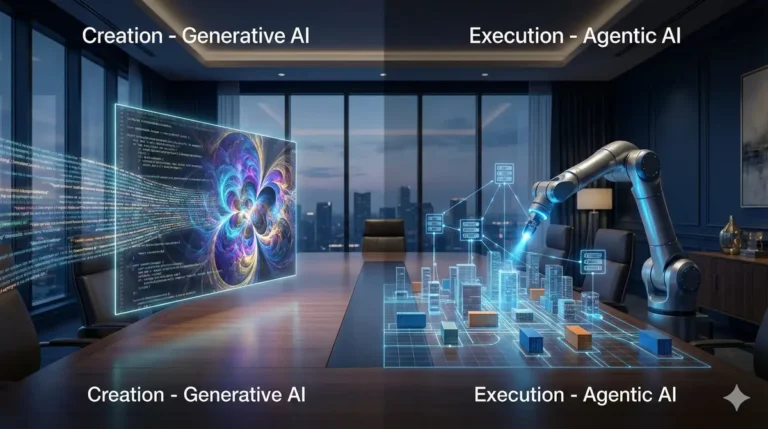
For the last two years, your Board has likely been asking about “Generative AI” (ChatGPT) — tools that create content. Now, the conversation is shifting. The 2026 executive agenda is about Agentic AI — autonomous systems that execute work.
This is not just a technical upgrade; it is a fundamental shift in how enterprises operate. Agentic AI moves us from asking a chatbot to “write an email” to commanding an autonomous agent to “manage the entire customer refund process.”
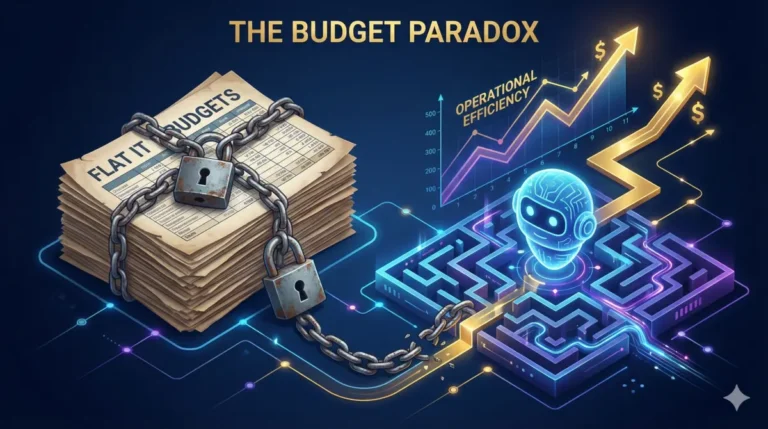
The Challenge for 2026 Most mid-sized enterprises are facing a “Budget Paradox”: IT budgets are flat, yet the pressure to deploy these autonomous agents is exploding. You cannot hire a massive internal AI R&D team to solve this. You need a smarter approach.
Why This Guide Exists: I wrote this guide for the CIOs, CEOs, and IT Leaders who need to navigate this shift without breaking the bank. As a Fractional CIO and Strategy Consultant, I help organizations build the governance, the hybrid sourcing models, and the roadmaps required to deploy Agentic AI safely.
In this Cornerstone Guide, I will cover:
- The Definition: What Agentic AI actually is (and what it isn’t).
- The Strategy: How to move from “Pilots” to “Production” using a fractional leadership model.
- The Execution: How to use Global Strategic Resourcing to build these capabilities cost-effectively.
Summary: What Is Agentic AI and How Does It Differ from Other AI Types?
- Agentic AI consists of AI agents that mimic human decision-making to solve problems in real time.
- Agentic AI combines multiple types of artificial intelligence, including LLMs, planning AI, and reinforcement learning.
- Agentic AI operates through a structured pathway that includes perceiving, reasoning, acting, and learning.
- Agentic AI is an artificial intelligence system that can accomplish a specific goal with limited supervision.
Unlike traditional or generative AI, agentic AI systems exhibit autonomy, goal-driven behavior, and adaptability, enabling them to set goals, plan, and execute tasks with minimal human intervention.
Key Takeaways
- Beyond generative AI: Agentic AI builds on large language models (LLMs) but adds orchestration of tools, workflows, and other agents to achieve complex business outcomes autonomously.
- Strategic imperative for 2025: As enterprises move from AI pilots to production systems, CIOs and business leaders who understand agentic AI will drive competitive advantage, operational efficiency, and organizational resilience.
- This article serves as your pillar guide: This comprehensive resource on bluephakwe.com covers AI strategy, governance, and practical implementation—future articles on architecture, governance frameworks, and vertical use cases will link back here.
- Practical CIO perspective: As a former CIO and current AI/IT strategy consultant providing fractional CIO services, I’ve structured this guide around real operating model changes, sourcing decisions, and strategic planning rather than abstract theory.
- Action-oriented framework: You’ll find concrete guidance on building your agentic AI roadmap, from initial discovery through production deployment and ongoing governance.
What Is Agentic AI? (Authoritative Definition for CIOs)

Agentic AI consists of AI agents that mimic human decision-making to solve problems in real time. For enterprise leaders, agentic AI can be defined precisely: it consists of one or more AI agents that can set sub-goals, plan execution sequences, take actions across systems, and adapt their approach—all without requiring step-by-step human instructions.
Agentic AI operates through a structured pathway that includes perceiving, reasoning, acting, and learning. This technology emerged prominently in 2023-2024 as large language models like GPT-4, Claude 3, and Gemini matured alongside new agent frameworks capable of calling external tools, APIs, and enterprise services. The result is an AI system that moves beyond answering questions to actually completing work.
Agentic AI combines multiple types of artificial intelligence, including LLMs, planning AI, and reinforcement learning, to enable thinking, acting, and adapting. It is a subset of generative AI that focuses on the orchestration and execution of agents.
Agentic AI is an artificial intelligence system that can accomplish a specific goal with limited supervision. These systems exhibit autonomy, goal-driven behavior, and adaptability, and are designed to operate with a higher degree of autonomy than traditional AI. Agentic AI can set goals, plan, and execute tasks with minimal human intervention, making it transformative for enterprise operations.
The classic four-stage model (perceive, reason, act, learn) extends into a practical six-stage enterprise loop:
- Perception: Gathering data from APIs, sensors, enterprise applications, and user inputs
- Reasoning: Analyzing information using LLMs and planning algorithms to understand context
- Goal setting: Breaking down high-level objectives into actionable sub-goals
- Decision-making: Weighing options and selecting the best course of action
- Execution: Invoking tools, APIs, and workflows to carry out decisions
- Learning/adaptation: Refining approaches based on feedback through reinforcement learning
What makes agentic AI transformative is its ability to operate across multiple systems – your CRM, ERP, HRIS, cloud services – and orchestrate complex workflows rather than simply generating content or answering queries.
Consider a concrete example: an AI agent managing your weekly marketing campaign. It pulls analytics data from your marketing platform, drafts and schedules messages based on performance patterns, runs A/B tests autonomously, and updates strategy based on results. This happens continuously without someone typing prompts every hour.
For readers seeking a broader context, the OECD AI Principles provide foundational guidance on responsible AI development that applies directly to agentic systems.
Agentic AI vs. Traditional and Generative AI
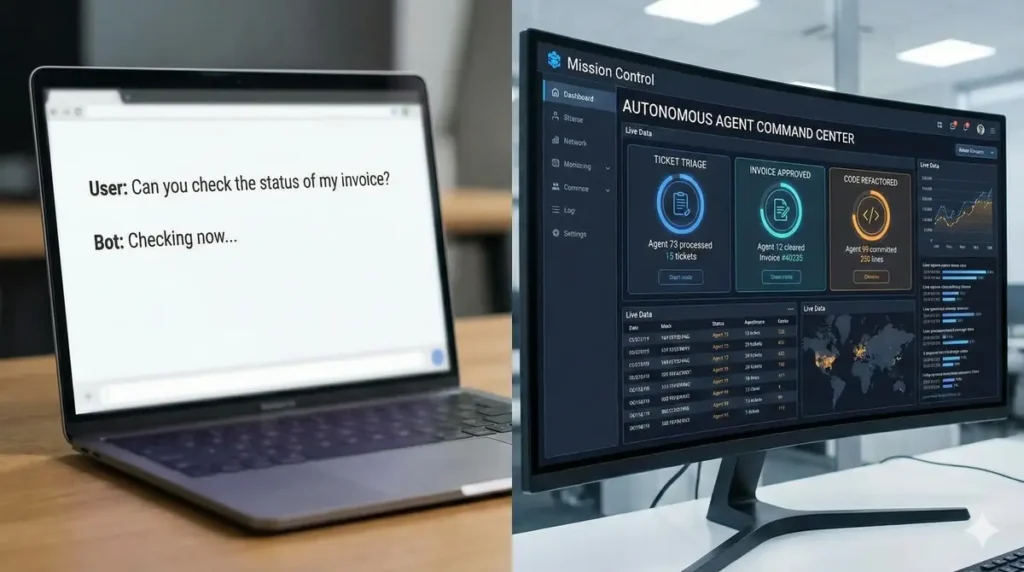
Understanding where agentic AI fits in the AI landscape is essential for CIOs making investment decisions. Three distinct categories have emerged, each with different capabilities and limitations:
| AI Type | Customer Service Capability |
|---|---|
| Traditional | Chatbot routes customers to correct department based on keywords |
| Generative | Assistant answers questions about products, policies, returns |
| Agentic | Triages issue, opens support ticket, updates CRM, applies resolution, follows up with customer, escalates only when necessary |
- Traditional AI (Rule-Based/Statistical)
- Emerged in practical enterprise use during the 2010s
- Examples include fraud detection models, recommendation engines, and predictive maintenance systems
- Operates reactively within tightly defined parameters
- Excels at specific tasks but cannot adapt beyond its training scope
- Requires explicit programming for each new capability
- Generative AI
- Became mainstream around 2022 with ChatGPT and similar systems
- Creates new content—text, images, code—from natural language prompts
- Waits for human instructions before acting
- Lacks persistent goals or memory between sessions (in basic implementations)
- Cannot independently access tools or systems without human orchestration
- Agentic AI
- Represents the current frontier, maturing through 2024-2025
- Uses LLMs as a reasoning engine while connecting to external tools and APIs
- Maintains long-term goals in memory systems
- Autonomously decides what to do next based on context
- Can coordinate with other agents in multi-agent systems
Forward-thinking enterprises increasingly combine all three layers: existing machine learning models handle specialized tasks, generative AI models create content and assist users, and agentic orchestration coordinates everything toward business outcomes.
Core Capabilities and Architecture of Agentic AI
This section provides CIOs and architects with a conceptual reference model for understanding how agentic systems work. Rather than diving into code, we’ll focus on the building blocks that matter for strategy and procurement decisions.
Perception: How Agents Gather Information
- Agents collect data through REST APIs, application programming interfaces, logs, IoT sensors, and enterprise data sources
- Integration with enterprise software applications like ERP, CRM, and ITSM systems provides business context
- Real-time data quality directly impacts decision accuracy
- Agents can process data from multiple modalities: text, structured databases, and sensor readings
Reasoning and Planning: The Thinking Layer
- Large language models provide the core reasoning engine for understanding natural language prompts and context
- Chain-of-thought prompting enables step-by-step problem solving
- Planning algorithms (sometimes classical AI planners) decompose goals into executable workflows
- Natural language processing capabilities allow agents to understand human intent accurately
Memory and Context: Enabling Continuity
- Short-term context windows in LLMs handle immediate conversation and task context
- Long-term memory via vector databases and knowledge graphs enables agents to remember past interactions
- Document stores provide access to policies, procedures, and historical data
- This combination allows agents to maintain context over days or weeks of operation
Action and Tool Use: Getting Things Done
- Agents invoke REST APIs to read and write data across systems
- Integration with RPA bots extends reach into legacy applications
- Workflow engines like UiPath and Power Automate provide process execution infrastructure
- Direct database access and SaaS integrations enable end-to-end task completion
Learning and Adaptation: Continuous Improvement
- Reinforcement learning allows AI agents to learn from outcomes and adjust behavior
- Human feedback loops enable the correction and refinement of agent policies
- MLOps and LLMOps practices ensure systematic model management
- Continuous monitoring identifies drift and performance degradation
Architectural Patterns for Enterprise Deployment
| Pattern | Description | Best For |
|---|---|---|
| Single Agent | One agent handles end-to-end process | Simple, well-defined workflows |
| Hierarchical | Conductor agent coordinates specialist agents | Complex processes requiring multiple AI agents |
| Decentralized | Autonomous agents collaborate peer-to-peer | Scalable, resilient systems where agents negotiate |
Orchestration layers – whether LangChain, Microsoft AutoGen, or enterprise automation platforms – coordinate agent activities, monitor performance, handle failures, and provide the governance infrastructure that production deployments require.
Autonomy, Proactivity, and Specialization in Agentic AI
What fundamentally distinguishes agentic AI from earlier automation is its capacity to act independently and anticipate needs. This isn’t just faster automation—it’s a different category of capability that changes how organizations operate.
Autonomy: Acting Within Guardrails
- Autonomous agents operate without continuous human prompts while respecting defined boundaries
- Enterprises configure allowed scopes: “approve purchases up to $5,000” or “triage incidents but escalate P1s”
- The goal is minimal human intervention for routine decisions while maintaining constant human oversight for exceptions
- Autonomy levels can be adjusted as trust in the system grows
Proactivity: Anticipating Rather Than Reacting
- Agents monitor signals continuously: SLA thresholds, inventory levels, customer churn indicators
- When conditions warrant action, agents initiate workflows—opening tickets, sending alerts, adjusting configurations
- This proactive behavior catches problems before they escalate
- The shift from reactive to proactive represents a fundamental change in how work gets done
Specialization: Domain-Specific Expertise
- Effective enterprise deployments create specialized agents for specific functions
- A “Finance Reconciliation Agent” knows your chart of accounts, approval workflows, and compliance requirements
- An “HR Onboarding Agent” understands your HRIS, provisioning systems, and policy documents
- Specialization enables agents to perform complex tasks within their domain while collaborating with other agents for cross-functional work
Hierarchical vs. Decentralized Multi-Agent Systems
Think of hierarchical systems like traditional project management: one agent acts as coordinator, assigning tasks to specialists and aggregating results. This provides clear governance but can create bottlenecks.
Decentralized multi-agent systems resemble self-organizing teams: agents negotiate directly, share information peer-to-peer, and coordinate without central control. This offers resilience and speed but requires more sophisticated governance.
For IT and AI strategy, the key insight is designing a “portfolio of agents” aligned to business capabilities. Rather than isolated pilots, consider how agents map to your operating model and enterprise architecture.
Enterprise Use Cases: From Automation to Strategic Advantage
The real value of agentic AI emerges in specific business applications. This section catalogues use cases relevant to CIOs and digital transformation leaders.
Customer and Citizen Service
- Autonomous triage of incoming requests across email, chat, and social channels
- Personalized responses drawing on customer history and enterprise data
- Automatic case creation with full context in your CRM
- Knowledge base updates based on resolution patterns
- Intelligent escalation to human agents when complexity exceeds agent capability
- Significant reduction in first-response time and resolution cycles
IT Operations and Cybersecurity
- Continuous monitoring of logs, metrics, and security alerts
- Automated incident detection with contextual analysis
- Proposed or automatic remediation for known issue patterns
- ITSM ticket creation and updates with full diagnostic information
- Coordination with SOAR platforms for security response
- Reduction in mean time to resolution and analyst toil
Supply Chain Management and Operations
- Demand forecasting that adapts to market signals in real-time
- Automatic adjustment of reorder points based on supply conditions
- Shipment rescheduling when delays are detected
- Cross-system coordination between ERP, WMS, and logistics partners
- Agents that optimize supply chains by balancing inventory costs against stockout risks
Financial Services
- Real-time fraud monitoring with adaptive detection models
- Automated KYC checks integrating multiple data sources
- Risk scoring that incorporates market conditions
- Regulatory reporting automation with audit trails
- Guardrails ensuring human oversight for high-value decisions
Healthcare and Life Sciences
- Appointment scheduling and patient data coordination
- Prior authorization automation with payer systems
- Clinical note summarization for physician review
- Literature scanning for relevant research
- Critical emphasis on privacy, compliance, and safety guardrails
Software Development and IT Modernization
- Code generation and refactoring assistance
- Automated test creation and execution
- Log analysis and performance optimization recommendations
- Documentation generation from codebases
- Architecture analysis for legacy modernization projects
Internal Knowledge Management
- Conversational access to policies, procedures, and enterprise documents
- Natural language queries that return actionable answers
- Workflow triggering from conversation: “Book my travel under policy X”
- Reduced time searching for information across siloed systems
Future articles on bluephakwe.com will provide deep dives into vertical use cases—agentic AI in banking, healthcare, manufacturing, and African public sector services.
Agentic AI Strategy for CIOs and Business Leaders
This section represents the strategic core of this article, drawing on my experience as a former CIO and current AI/IT strategy consultant providing fractional CIO services.
Setting Vision and Scope
Before implementing agentic AI, clarify your strategic intent:
- Optimize existing processes: Reduce costs, improve speed, enhance quality in current operations
- Create new digital products: Build AI-powered services that generate revenue or differentiate your offering
- Transform business models: Fundamentally change how your organization creates and delivers value
Each path requires different investment levels, risk tolerance, and organizational change. Most enterprises will pursue a portfolio across all three, sequenced over a 3-5 year horizon.
Portfolio Assessment: Where to Start
Prioritize processes that are:
- Data-rich with accessible, quality information
- Rules-heavy with documented policies and procedures
- Repetitive tasks that consume significant human time
- High-volume with clear patterns agents can learn
Strong initial candidates include invoice processing, claims handling, IT ticket triage, employee onboarding, and report generation. These allow you to incorporate agentic AI where value is clear and risk is manageable.
Solving the Execution Challenge: The Budget Paradox
While defining the vision is the first step, execution presents a significant hurdle for mid-sized enterprises in 2026: the “Budget Paradox.”
IT budgets remain flat, yet the pressure to deploy autonomous agents is exploding. Most organizations cannot afford to hire massive internal AI R&D teams to solve this, nor can they afford to remain stuck in analysis paralysis while competitors automate.
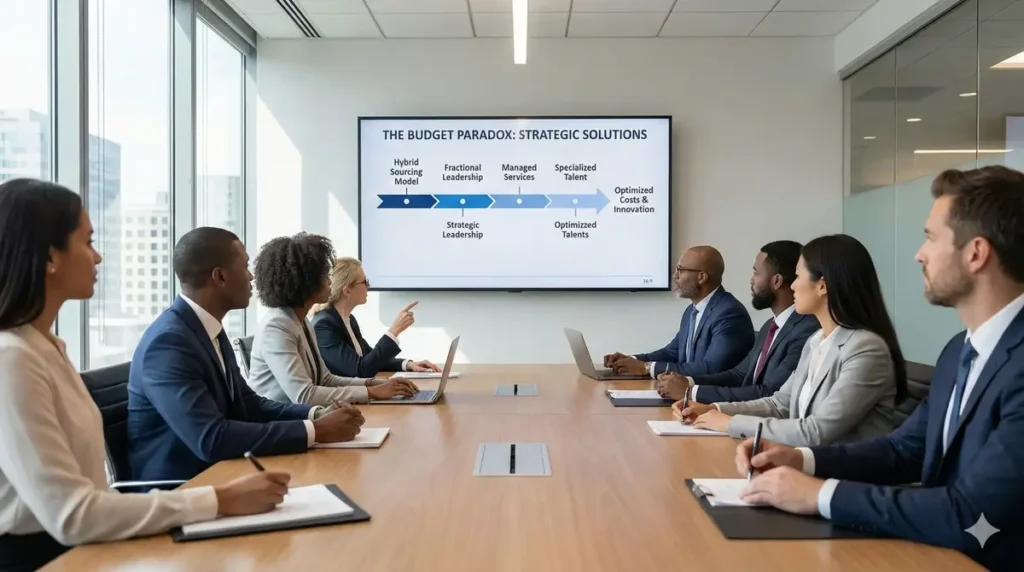
Successful implementation requires a fundamental shift in your operating model. This involves moving away from traditional hiring toward Fractional Leadership and Global Strategic Resourcing. This approach allows you to access high-level governance and technical execution without the overhead of full-time executive hires or local bidding wars.
We have developed a dedicated implementation framework specifically for mid-sized enterprises facing this constraint.
Read the Full Strategy Guide: Agentic AI Strategy Roadmap: Solving the Budget Paradox for Mid-Sized Enterprises.
Governance, Ethics, and Risk Management in Agentic AI

Greater autonomy amplifies both value and risk. For CIOs and boards, robust security measures and governance frameworks are non-negotiable prerequisites for agentic AI deployment.
Key Risk Categories
| Risk Type | Examples | Mitigation Approach |
|---|---|---|
| Operational | Wrong actions, system outages, cascading failures | Testing, monitoring, rollback capabilities |
| Ethical | Biased decisions, unfair outcomes, lack of transparency | Bias testing, diverse review teams, explainability |
| Legal | Regulatory non-compliance, liability exposure | Legal review, compliance frameworks, audit trails |
| Reputational | Customer trust erosion, public relations incidents | Transparency, incident response, stakeholder communication |
Framework Alignment
Agentic systems should align with established governance frameworks:
- NIST AI Risk Management Framework provides a practical structure for mapping, measuring, managing, and governing AI-related risk across the lifecycle.
- OECD AI Principles establish baseline expectations for responsible AI
- EU AI Act requirements apply for organizations operating in or serving European markets
- Industry-specific regulations (HIPAA, SOX, PCI-DSS) impose additional constraints
- ISO/IEC 42001 provides a management-system approach for governing the responsible development, provision, and use of AI systems.
Practical Guardrails
Effective governance includes:
- Role-based access controls limiting what each agent can do
- Approval thresholds requiring human sign-off above certain risk levels
- Human-in-the-loop checkpoints for sensitive decisions
- Sandbox environments for testing before production deployment
- Comprehensive logging and audit trails for all agent actions
- Kill switches to immediately disable agents if problems emerge
Data Protection and Privacy
Critical considerations for protecting sensitive information:
- Compliance with GDPR, CCPA, and regional regulations like POPIA in South Africa
- Data minimization principles—agents access only what they need
- Careful evaluation of external LLM APIs versus private model deployment
- Encryption and access controls for patient data, financial records, and personal information
- Clear data retention and deletion policies
AI Ethics and Review Process
Establish multidisciplinary review teams, including:
- Business stakeholders who understand the operational context
- Legal and compliance for regulatory requirements
- Security for data protection and access control
- Data science for technical feasibility and bias assessment
- HR for workforce impact considerations
Review use cases before deployment, not after problems emerge.
Incident Response for AI Systems
Develop AI-specific incident response plans:
- Procedures to pause or roll back problematic agents
- Communication protocols for stakeholders and customers
- Root cause analysis processes for AI failures
- Documentation requirements and lessons learned capture
Transparency Commitments
Build trust through openness:
- Inform employees and customers when they interact with AI-powered agents
- Document agent capabilities and limitations clearly
- Provide meaningful ways to contest or appeal automated decisions
- Maintain human agents as escalation paths for complex challenges
For additional strategic frameworks, the World Economic Forum’s AI Governance resources provide a valuable perspective on enterprise AI strategy.
Build or Buy? Platforms, Tools, and Sourcing Options
Most organizations will mix in-house development, platform adoption, and external partnerships. Understanding the landscape helps you make informed decisions.
Platform Landscape Overview
| Category | Examples | Strengths |
|---|---|---|
| Cloud AI Services | Google Vertex AI, Azure AI, AWS Bedrock | Scalability, managed infrastructure, broad model access |
| Orchestration Frameworks | LangChain, Microsoft AutoGen, CrewAI | Flexibility, multi-agent coordination, developer control |
| Enterprise Automation | UiPath, Power Platform, ServiceNow | Integration with existing workflows, governance features |
| Vertical Solutions | Contact center AI, IT ops assistants | Speed to value, domain expertise built-in |
Platform Selection Criteria
When evaluating agentic AI tools, consider:
- Data residency: Where will data be processed and stored?
- Integration: How easily does it connect with your existing enterprise systems?
- Multi-agent support: Can it handle multi-agent systems with coordination?
- Governance features: Does it provide monitoring, logging, and access control?
- Total cost of ownership: Including licensing, infrastructure, and operational costs
Build vs. Buy Trade-offs
| Factor | Build Custom | Buy/Configure |
|---|---|---|
| Flexibility | High—exactly what you need | Limited to platform capabilities |
| Speed to value | Slower—months of development | Faster—weeks to deploy |
| Vendor lock-in | Low—you own the code | Higher—platform dependencies |
| Skill requirements | Significant AI/ML expertise | Lower—vendor support available |
| Ongoing maintenance | Your responsibility | Shared with vendor |
Sourcing Models
Organizations have multiple options for enabling AI agents:
- Internal AI Center of Excellence: Build dedicated teams with full ownership
- Co-sourcing: Partner with specialized firms while building internal capabilities
- International resource pools: Leverage global AI and IT talent for development and operations
- Managed services: Outsource ongoing operations to specialized providers
As an AI strategy consultant and fractional CIO, I help organizations structure RFPs, evaluate vendors objectively, and orchestrate global delivery teams. This ensures you get the right mix of capabilities without the overhead of building everything internally.
For detailed platform comparisons, vendor-neutral analyst reports from firms like Gartner and Forrester provide valuable benchmarking data.
Implementation Roadmap: From Pilot to Production Agentic AI
This phased roadmap provides a pragmatic framework CIOs can adapt. Implementing agentic AI successfully requires treating these initiatives as products, not one-off projects.
Phase 1: Discover and Align
- Stakeholder workshops to identify pain points and opportunities
- Value mapping connecting AI capabilities to business outcomes
- Candidate process identification using the prioritization criteria discussed earlier
- Success metrics definition: what does “working” look like?
- Constraint identification: data, security, compliance, and cultural factors
Phase 2: Experiment and Prototype
- Create proofs of concept with one or two agents
- Use synthetic or limited real data to validate approaches
- Test technical feasibility: can the agent actually do what we need?
- Validate user acceptance: will people trust and use it?
- Document lessons learned and refine requirements
Phase 3: Design for Scale
- Define reference architecture for enterprise deployment
- Build data pipelines with appropriate quality controls
- Implement security controls and access management
- Design monitoring and observability infrastructure
- Establish retraining processes for model maintenance
- Integrate with existing workflow and identity systems
Phase 4: Govern and Harden
- Define SLAs for availability, performance, and accuracy
- Implement risk controls and escalation paths
- Complete documentation for operations and audit
- Conduct red-teaming and adversarial testing
- Perform security assessments and penetration testing
- Obtain required approvals from governance bodies
Phase 5: Deploy and Iterate
- Roll out to selected business units in controlled manner
- Capture user feedback systematically
- Monitor KPIs and compare to baseline metrics
- Refine prompts, tools, and policies based on performance
- Expand scope as confidence and capability grow
- Celebrate and communicate wins to build organizational momentum
Product Mindset
Treat agentic AI initiatives as products with:
- Dedicated ownership and accountability
- Ongoing roadmaps and feature backlogs
- Regular review cycles and stakeholder engagement
- Continuous improvement rather than “done” mentality
Subsequent articles on bluephakwe.com will elaborate each phase with checklists, templates, and case examples from different industries.
The Future of Agentic AI in Business and Society

Agentic AI represents a multi-year transformation, not a short-lived trend. The organizations that build capability now will define competitive advantage for the coming decade.
Emerging Directions
- Multi-agent ecosystems spanning organizational boundaries
- Agents from different companies negotiating directly (supply chain partners, service providers)
- Sector-specific AI collaboratives sharing models and best practices
- Increasingly sophisticated reasoning and planning capabilities
- Tighter integration between agentic systems and physical operations
Workforce Implications
- Roles will shift fundamentally:
- From execution to oversight, design, and exception handling
- Emphasis on uniquely human skills: judgment, creativity, empathy
- Critical need for reskilling and upskilling programs
- New career paths in AI operations, governance, and strategy
- Importance of helping employees see AI as augmentation, not threat
Regional Perspectives
- Emerging markets and African economies have unique opportunities:
- Leapfrog legacy systems by building cloud-native agentic solutions
- Address talent shortages through intelligent automation
- Improve citizen services without massive infrastructure investment
- Participate in global AI ecosystem as both consumers and contributors
- Develop domain expertise in regional challenges like agricultural supply chains and financial inclusion
Responsible Innovation
- As we enhance productivity through agentic systems, we must:
- Align with societal values and community expectations
- Address digital divides in access and capability
- Ensure agentic AI augments rather than replaces human judgment where it matters most
- Prevent unintended consequences through careful design and governance
- Maintain transparency and accountability as systems grow more autonomous
Conclusion: Your Mandate for 2026
Agentic AI is not a “future trend”—it is the competitive battleground of the next 24 months. The organizations that figure out how to deploy autonomous agents safely will see exponential gains in productivity. Those that remain stuck in “Analysis Paralysis” will find their cost structures becoming uncompetitive.
The “Blue Phakwe” Way Forward: You do not need a $50 million budget to start. You need Strategy and Governance.
- Stop the Bleeding: Use a Fractional CIO to audit your current IT spend and redirect waste toward innovation.
- Source Smart: Don’t try to hire scarce AI talent locally. Leverage our Global Strategic Resourcing model to deploy hybrid squads of global experts governed by local leadership.
- Govern First: Do not deploy autonomous agents without a safety framework. The risk of “Shadow AI” is real, and the cost of a mistake is high.
Are You Ready for Agentic AI?
The technology is ready. The question is: Is your operating model ready?
If your leadership team is exploring Agentic AI, start with readiness, governance, and operating-model clarity. Book a Fractional CIO or AI Strategy Advisory discussion with Blue Phakwe, and let’s define the roadmap before autonomous systems are deployed into the business.
|
Don’t navigate this transition alone. Book a Fractional CIO Strategy Audit with us today, and let’s build your roadmap for 2026 and beyond. |
Frequently Asked Questions
1. How is agentic AI different from using a normal chatbot in my organization?
A normal chatbot primarily answers questions or routes users to appropriate resources—it waits for your input and responds within a single conversation. Agentic AI goes substantially further: it can autonomously call external tools and systems, update records in your CRM or ERP, initiate workflows across multiple applications, and monitor progress toward defined goals over time.
When you ask an agentic system to “resolve customer billing discrepancies,” it doesn’t just explain how—it actually connects to your billing system, investigates the issues, applies corrections where appropriate, and reports back on what it did. This execute tasks capability versus merely advising makes agentic AI transformative for business processes.
2. Do I need a full-time AI team to start with agentic AI?
No, smaller organizations can begin effectively without dedicated AI staff. Start with a combination of vendor platforms (which provide much of the infrastructure), specialized external partners for implementation, and fractional CIO or AI strategy support for guidance and oversight. This approach lets you validate value and build understanding before investing in permanent hires.
As your agentic initiatives prove their worth and expand in scope, you can gradually build internal capabilities—hiring your first AI engineer, training existing IT staff in LLMOps, or establishing a small center of excellence. The key is matching your organizational model to your current maturity and ambitions.
3. Which processes should I avoid automating with agentic AI at first?
Avoid starting with processes that are highly sensitive, safety-critical, or heavily regulated, where errors could cause significant harm. Medical diagnosis, high-value credit approvals, legal decisions affecting individual rights, and critical infrastructure control are examples where you should build substantial expertise and trust before deploying autonomous agents.
Instead, begin with lower-risk, well-documented processes: automating repetitive tasks like invoice processing, IT ticket triage, report generation, or standard customer inquiries. These provide clear value while allowing you to develop governance capabilities and organizational confidence that will serve you when tackling complex challenges later.
4. Can I use public cloud LLMs if my data is sensitive or regulated?
You have options beyond simply avoiding public cloud services entirely. Many providers now offer private instances where your data remains isolated and isn’t used for model training. Virtual private cloud deployments provide additional security controls. You can also implement data minimization – structuring prompts and workflows so that sensitive information stays within your secure environment while less sensitive tasks use cloud APIs.
Some organizations use on-premise models for handling patient data or financial records while using cloud services for general productivity. Always consult with your data protection and compliance teams before finalizing your architecture—they’ll help you navigate regulations like GDPR, HIPAA, or regional requirements like POPIA.
5. How do I measure success for an agentic AI initiative?
Combine quantitative and qualitative metrics tracked over time. Quantitative measures include cycle time reduction (how much faster tasks complete), error rates (are agents making fewer mistakes than previous processes), cost savings (reduced labor, fewer escalations), and SLA improvements (faster response times, higher first-contact resolution).
Qualitative measures capture user satisfaction (do employees find agents helpful?), workload reduction (are people freed for higher-value work?), and customer experience (are interactions improving?). Establish baselines before deployment, track metrics weekly or monthly, and expect performance to improve as agents learn and as you refine their capabilities.
A few examples of strong leading indicators: reduction in average handle time, decrease in tickets requiring human intervention, and improvement in employee satisfaction scores for processes where agents assist.