
Technology Staff Augmentation: From Outsourcing to Global Strategic Resourcing
I spent fifteen years as a CIO. During that time, I watched the language around external talent shift from “contractors” to “outsourcing” to “staff augmentation.” Today, I use none of those terms with my clients. What we’re doing now is Global Strategic Resourcing—and if you’re still treating technology staff augmentation as a procurement exercise, you’re solving the wrong problem.
The reality since 2020 is stark. AI adoption has accelerated faster than anyone predicted. Cybersecurity incidents have multiplied. And wage inflation in London, New York, and Berlin has made local-only hiring strategies unsustainable for any organization with serious growth ambitions. Industry projections tell us that 90% of organizations will face an IT skill shortage by 2026. That’s not a talent gap—that’s a structural market failure that requires a strategic response.
I’ve personally moved large enterprises from local-only hiring to hybrid global teams. The shift isn’t easy. It requires governance frameworks, new operating models, and honest conversations at the board level about risk. But it works. This article is about governed scaling of engineering and security capacity—not generic outsourcing tips that belong in a procurement handbook.
Key Takeaways
- Technology staff augmentation is no longer about cost arbitrage—it’s Global Strategic Resourcing that addresses structural talent shortages boards must now treat as enterprise risk.
- Local markets in the US, UK, and EU cannot meet demand for niche skills like Data Science in Cybersecurity(threat modeling, anomaly detection, SOC analytics) and Programming Languages for AI (Python, Rust, Julia) at scale.
- A hybrid global team model combining onshore, nearshore, and offshore talent is now a board-level decision about talent risk, not just a procurement line item.
- Google Cybersecurity Certificate-level credentials provide a practical, verifiable baseline for vetting junior global security talent quickly and consistently.
- Blue Phakwe Consulting helps CTOs and boards design, test, and govern these models—start with a Global Talent Risk Assessment to map your talent gaps and feasible geographies.
Redefining Technology Staff Augmentation as Global Strategic Resourcing

Let me be direct: if your board still thinks of staff augmentation as “renting developers,” you need to reframe the conversation. This isn’t an HR decision. It’s a strategic capability decision that sits at the same level as cloud architecture or M&A.
Local talent scarcity—particularly from 2023 through 2026—in areas like cloud-native engineering, AI, and cybersecurity makes pure onshore hiring non-viable for growth targets. The average time to fill a permanent position is 42 days in normal markets. For specialized skills, double that. For truly specialized expertise in emerging domains, you may never fill the role locally at all.
Position technology staff augmentation as strategic access to global, specialized capability under your direct control. This is not body-shopping. This is not time-and-materials outsourcing where you lose visibility and ownership. Your internal team retains product leadership, architectural decisions, and delivery accountability. External professionals integrate into your existing team, your tools, your ceremonies.
Consider a concrete example: a mid-sized bank needs 10 senior engineers with Data Science in Cybersecurityexperience—threat modeling, anomaly detection, SOC analytics—within 90 days. In London or New York, that’s effectively impossible through traditional hiring. Through global strategic resourcing, it’s achievable, with qualified candidates sourced from curated pools across Eastern Europe, South Asia, and Africa.
The constraint is particularly acute for Programming Languages for AI. Engineers proficient in Python for machine learning are in high demand everywhere. Those with Rust expertise for high-performance inference or Julia for numerical computing are genuinely rare in North America and Western Europe. The global talent pool offers access to skilled professionals with these highly specialized skills that simply don’t exist at scale in your local market.
Treat augmentation like portfolio construction: mix of skill levels, geographies, and contract horizons aligned to your roadmap risk. This is how you address immediate business needs while building resilience into your talent strategy.
Where Technology Staff Augmentation Delivers Strategic Advantage
Staff augmentation services are justified only where they change business outcomes—speed to market, operational resilience, or regulatory posture. If you’re augmenting just to fill seats, you’re doing it wrong.
Here are the use cases that matter in 2024–2026:
- Cybersecurity & Data Science Fusion: Augment your SOC and engineering teams with specialists in Data Science in Cybersecurity. These professionals bring feature engineering expertise on logs, ML models for anomaly detection, and attack path analysis capabilities that most internal teams haven’t developed. This niche skill set is essential for modern threat detection.
- AI Product Delivery: Bring in engineers strong in Programming Languages for AI—Python, Rust, Julia—plus MLOps to hit aggressive AI feature releases. When your development team lacks specialized talent for your AI roadmap, waiting 6-9 months for a local hire means your competitors ship first.
- Cloud Modernization at Scale: Add remote squads skilled in AWS/Azure/GCP migration, zero-trust networking, and container security. These augmented team members can compress 3-year roadmaps into 18–24 months, accelerating project completion without burning out your current team.
- Regulatory Response Teams: Build small, globally distributed teams to respond to requirements like NIS2, DORA, or updated PCI DSS without derailing core product delivery. These specific projects have fixed deadlines and require specialized resources you may not need permanently.
- Legacy & Edge Skills: Leverage global pools where legacy mainframe, SCADA, or telecom protocol skills still exist. These specialized skills are vanishing from Western markets but remain available globally to de-risk 2020s modernization programs.
- 24/7 Operations Coverage: Staff augmentation enables follow-the-sun security operations and incident response. Rather than demanding night shifts from your in house team, distribute coverage across time zones with augmented staff who work normal hours in their region.
Nearshoring vs Offshoring vs Onshoring: A Decision Matrix for CTOs and Boards

Choosing your geography model for technology staff augmentation is a board-level risk decision, not a procurement line item. Here’s the framework I use with clients.
Onshoring (same country) delivers the highest cost but the lowest regulatory and cultural friction. It works best for roles with heavy stakeholder interaction, strategic decision-making authority, or strict data residency requirements. Think UK public sector health data or US defense contractors. Your in-house employees and external professionals work side by side with minimal friction.
Nearshoring (similar time zone) balances cost, collaboration, and language familiarity. Western Europe to Eastern Europe. US to Latin America. South Africa to broader Africa. You get 2–4 hours of time zone difference, which means substantial real-time overlap for standups, pair programming, and incident response. This model offers flexible staffing solutions without the communication challenges of distant offshoring.
Offshoring (distant regions) optimizes for follow-the-sun operations, 24/7 security monitoring, and well-structured build work. US to India or the Philippines. EU to South Asia. Highest savings if well-managed, but requires carefully designed access controls, contracts, and explicit communication protocols.
Comparison by Dimension:
| Dimension | Onshore | Nearshore | Offshore |
|---|---|---|---|
| Time Zone Overlap | Full overlap | Moderate-high (2-4h difference) | Planned overlap windows only |
| Cost Efficiency | Lowest savings | Moderate savings | Highest savings if well-managed |
| Regulatory & Data Residency | Easiest to assure | Manageable with GDPR or similar frameworks | Requires careful access controls and contracts |
| Access to Niche Skills | Constrained local market | Strong (Poland/Romania for AI, LATAM for platform engineering) | Deep (India for cloud scale, Africa for emerging cybersecurity talent) |
| Communication Friction | Minimal | Low | Requires structured async practices |
The right answer is usually a blend. Your project manager for a critical AI initiative might be onshore. Your software developers building features might be nearshore. Your security monitoring team might be offshore for 24/7 coverage. Blue Phakwe Consulting treats this as a strategic architecture decision mapped to your specific project requirements and regulatory exposure.
Vetting and Quality: From CVs to Proven Global Specialists
The main failure mode of team augmentation services is weak vetting. When organizations treat global hiring like they’re ordering from a staffing agency catalog, they get catalog-quality results. Blue Phakwe Consulting enforces enterprise-grade standards because our clients operate in regulated environments where hiring full-time employees with the wrong security posture creates material risk.
Here’s the three-layer vetting model we apply:
Baseline Credentialing: Every candidate must demonstrate verifiable credentials appropriate to their role level. For junior cybersecurity and security operations talent in emerging markets—Africa, South Asia, Latin America—the Google Cybersecurity Certificate has emerged since 2023 as a credible baseline. It’s not sufficient on its own, but it filters out candidates without structured security training and proves investment in professional development. Similarly, for machine learning roles where resume inflation is rampant, we rely on specific benchmarks to verify expertise. (Read our guide on Evaluating AI Talent: Which Certification for Artificial Intelligence Actually Matters?).
Technical Depth: Credentials establish a floor, not a ceiling. For Data Science in Cybersecurity roles, vetting must include real-case work: log data feature engineering, detection rule development, and model evaluation against false positives and negatives. We want to see how candidates think about actual SOC problems, not just their familiarity with scikit-learn.
For Programming Languages for AI, we insist on code reviews or technical tests in Python plus at least one of Rust or Julia. We evaluate practical experience with frameworks—PyTorch, TensorFlow, ONNX runtimes—not just tutorial-level familiarity. Your software development standards shouldn’t drop because someone works remotely.
Security & Compliance: Every candidate working in regulated environments undergoes background verification appropriate to the sector. We verify understanding of access control principles, data handling requirements, and incident escalation protocols before anyone touches production systems.
Communication & Delivery Behavior: Soft factors are non-negotiable for teams embedded in banks, healthcare, and critical infrastructure. English fluency, stakeholder communication capability, and experience working in regulated environments with strict project timelines are baseline requirements, not nice-to-haves. Your new team members need to seamlessly integrate into existing ceremonies and communication patterns.
This rigorous staff augmentation process separates genuine specialists from resume-inflaters. It takes more time upfront but eliminates the costly churn that comes from hiring the wrong qualified candidates.
Blue Phakwe Consulting’s Technology Staff Augmentation Model

Blue Phakwe Consulting is a specialist in designing and governing Global Strategic Resourcing models, not a generalist recruiter pumping resumes through your inbox. We work primarily with CTOs, CIOs, and boards in sectors like financial services, energy, and public sector who are navigating 2022–2026 modernization cycles and need augmentation services that can withstand regulatory scrutiny.
Our role is to sit on your side of the table, not to maximize billable headcount. Here’s what that means in practice:
- Strategic Workforce Architecture: We map your 18–36 month technology roadmap to a blended staff augmentation model of onshore, nearshore, and offshore talent. The output is a workforce design that aligns capacity to your evolving business needs, not generic role descriptions.
- Security-First Global Talent Pools: We curate engineers and analysts with verifiable security baselines—including Google Cybersecurity Certificate holders, cloud security certifications, and audited project history. Every candidate in our talent pool has been vetted against technical expertise standards appropriate for regulated environments.
- Hybrid Team Operating Models: We design the rituals, SLAs, and project management tools integration so that augmented staff behave as one team with your existing engineers. Same standups. Same retros. Same definition of done. Seamless integration isn’t optional—it’s the design requirement.
- Regulatory & IP Protection Design: We ensure contracts, NDAs, and access patterns protect your intellectual property and comply with GDPR, POPIA, or sector-specific mandates. This matters especially for AI and cybersecurity work where your models and detection logic represent a competitive advantage.
- Continuous Talent Performance Monitoring: We provide metrics and dashboards covering velocity, incident rates, MTTR, and defect density. These allow you to track global teams against internal processes standards and trigger remediation or rotation when performance drifts.
We’re an it staff augmentation company that understands the difference between filling seats and enabling business outcomes.
From Request to Ramp-Up: Our Technology Staff Augmentation Process
Speed without governance is dangerous. A staff augmentation service provider that promises instant developers without understanding your security requirements, regulatory exposure, or architectural standards is setting you up for a costly cleanup later. Our process balances time-to-fill with risk controls.
Step 1: Clarify Strategic Need
We align with the CIO/CTO on whether the demand is structural or temporary. A multi-year AI program requires different sourcing than meeting deadlines for a 2025 regulatory requirement. This conversation determines geography mix, contract structures, and the level of investment in onboarding. Your project needs to shape everything downstream.
Step 2: Role Definition & Risk Profile
We define skills, seniority, data access level, and regulatory exposure for each role. This is especially critical for cybersecurity and AI functions where the wrong access controls create material risk. We document what success looks like, what tools the role will use, and how performance will be measured against project progress metrics.
Step 3: Global Sourcing & Vetting
We tap curated pools across regions—Eastern Europe, Africa, South Asia, Latin America—applying the vetting model described earlier. Baseline certifications, hands-on assessments, security screening, and communication evaluation. We typically present 3-5 highly skilled professionals per role, not 50 resumes for you to filter.
Step 4: Integration & Onboarding
We ensure augmented staff are integrated into your existing ceremonies—standups, retros, incident reviews—and tooling (Jira, GitLab, SIEM platforms). We work with your project manager to define the first 30 days, including access provisioning, security training, and relationship-building with internal team members. This is where seamless integration happens or fails.
Step 5: Ongoing Governance & Renewal
Quarterly reviews against your roadmap allow us to rotate skills as tech stacks evolve—perhaps adding Rust for AI optimization in 2025 as model serving requirements change. We monitor business demands and regulatory shifts to ensure your augmented capacity stays aligned with project delivery needs.
For most roles, we move from definition to first productive sprint in 2–3 weeks. Complex projects with specialized skills requirements may take 4–6 weeks. Either timeline beats the 42-day average for local hires—and that’s before accounting for the lengthy hiring processes required for truly specialized expertise.
Cost, Control, and Risk: When Staff Augmentation Beats Traditional Hiring

Stop comparing day rates to salaries. The real comparison is risk-adjusted delivery cost versus failed or delayed programs.
Traditional hiring in saturated markets like London or Silicon Valley means 6–9 month cycles for specialized talent. Often longer. Sometimes never. During that period, your development team is understaffed, your project timelines slip, and your competitors ship products while you’re still screening qualified candidates.
The staff augmentation model compresses this to 2–6 weeks for a functioning pod. You pay for hours worked, eliminating the expense burden of full time employees during slower periods. No recruitment costs. No long term commitments that create inflexibility. No office space you don’t need.
More importantly, staff augmentation offers better control than classical outsourcing. You retain product ownership, backlog control, and architectural decisions. Augmented team members work under your technical standards, use your project management tools, and participate in your ceremonies. Direct control stays with your organization.
Here are scenarios where the staff augmentation model is clearly superior:
AI Feature Delivery Under Time Pressure: You need to ship a new AI feature set in 2025 using specialists in Programming Languages for AI—Python for the models, Rust for high-performance inference. Your local market can provide 1–2 qualified candidates at extreme salaries, maybe. Global augmentation gives you access to tech talent at scale.
24/7 Security Operations: You need round-the-clock Data Science in Cybersecurity coverage for your SOC. Follow-the-sun teams across India, Eastern Europe, and North America beat local night shifts for coverage quality, cost effectiveness, and analyst retention.
Mid-Program Regulatory Pivot: DORA enforcement in 2025 forces a capability shift in your EU financial services operation. Global talent pools allow you to rebalance specialized skills in 30–60 days without layoffs or painful local restructuring. The benefits of staff augmentation show up precisely when your business needs rapid adaptation.
Structural Risk Diversification: Depending entirely on London or San Francisco for tech talent creates concentration risk. Wage shocks, visa policy changes, or political disruptions in a single location can cripple delivery. Global augmentation spreads that risk across multiple regions and vendors.
Common Failure Modes in Technology Staff Augmentation (and How to Avoid Them)
This section reflects lessons learned from real programs, not theoretical risk registers. I’ve seen each of these failures firsthand.
- Failure: Treating augmentation as a cheap vendor swap. This leads to low quality and high churn. You get whoever is available from a staffing agency, not specialists matched to your company processes. Remedy: Position it as strategic resourcing with rigorous selection, technical vetting, and deliberate integration into your internal team.
- Failure: Ignoring security baselines. Augmented software developers without proper training introduce new attack surfaces. One contractor with poor credential hygiene can compromise your entire environment. Remedy: Enforce minimum baselines like the Google Cybersecurity Certificate for relevant roles, plus mandatory internal security onboarding before production access.
- Failure: No clear ownership model. Augmented staff drift between teams, lack accountability, and never develop domain knowledge. No one knows who they report to or what project success looks like for them. Remedy: Define single-threaded ownership per squad. Align augmented staff on the same KPIs as internal teams. Make team members, not “resources.”
- Failure: Over-rotating vendors. Continual switching destroys team cohesion and institutional knowledge. Every new vendor means a new ramp-up time and relationship building. Remedy: Treat vendors and regions as long-term strategic partners. Periodic rebidding is healthy; constant churn is not. Build a stable, vast expertise base.
- Failure: Underinvesting in communication. Time zones amplify misalignment. What seems like a small miscommunication becomes a day of lost productivity when you can’t clarify until tomorrow. Remedy: Design explicit overlap windows and communication SLAs from day one. Async-first practices with deliberate sync points for complex projects.
- Failure: Ignoring local legal and IP realities. Rushed contracts that don’t protect code and models create long-term liability. In AI especially, unclear IP assignment can mean you don’t own the models your team built. Remedy: Involve legal early. Standardize strong IP and data-protection clauses. Never assume “standard” contracts cover your specific exposure.
How Technology Staff Augmentation Differs from Outsourcing and Managed Services
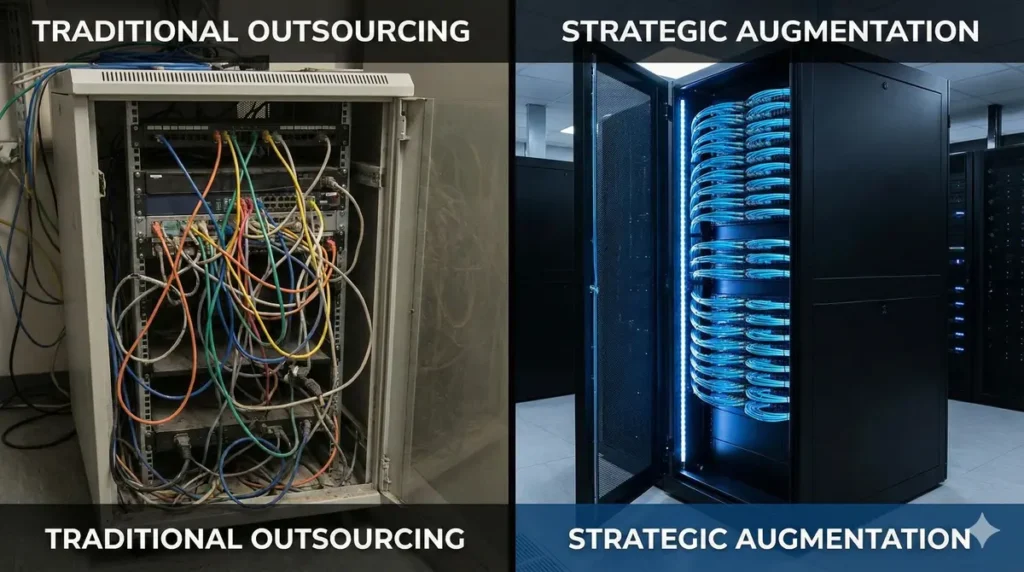
Many boards still conflate these models, leading to misaligned expectations and governance structures. Let me draw sharp operational distinctions.
Staff Augmentation: Global engineers join your teams, on your tools, under your product leadership. You hold delivery risk and architectural control. They’re external talent working as extensions of your internal processes. Your project manager directs their work. You own the code, the models, the outcomes. The hiring organization maintains full accountability.
Project Outsourcing: You transfer a defined outcome to a vendor. They manage team structure, methodology, and deliverables. You specify requirements and accept results. This works for well-bounded work but sacrifices direct control over how the sausage gets made. Individual contributors are invisible to you—you interact with a vendor project manager.
Managed Services: You transfer an ongoing function—managed SOC, cloud operations, help desk—with defined SLAs. Pricing ties to service levels, not hours. You care about outcomes (mean time to respond, uptime, ticket resolution) not activities. The vendor is responsible for staffing, tooling, and process—you’re a consumer of a capability.
Concrete examples:
- Building an internal AI product with specialized features: Staff augmentation. You need engineers who understand your product vision working directly with your architects.
- Creating a one-time data migration with defined success criteria: Project outsourcing. Hand off the scope, accept the result, move on.
- Running 24/7 SOC monitoring with defined SLAs: Managed services. You want coverage, not headcount management.
Conclusion: Solving the Talent Crisis Deliberately
Blue Phakwe Consulting helps clients choose a blend of these models. But when you need to bridge skill gaps in your engineering organization while maintaining strategic control, staff augmentation is the right lever. It combines the flexibility of external professionals with the integration and accountability of long-term project ownership.
The question isn’t whether to build global teams. That debate ended when 90% of organizations started facing IT skill shortages. The question is whether you’ll build them deliberately, with proper governance and strategic intent, or reactively, scrambling when your local talent market can’t deliver.
Contact Blue Phakwe Consulting for a Global Talent Risk Assessment. We’ll map your talent gaps to global sourcing strategies, identify regulatory constraints, and design a pilot that proves the model for your organization. Your 2024–2026 technology roadmap depends on talent you can’t hire locally. Let’s solve that problem together.
Need a Global Talent Risk Assessment?
Frequently Asked Questions (FAQ)
These FAQs address practical questions CTOs and boards raise that extend beyond the main narrative. They’re drawn from conversations I’ve had with technology leaders navigating these decisions.
1. How do I decide which roles must remain onshore versus going nearshore or offshore?
Apply a simple triage: roles with heavy stakeholder interaction, regulatory decision-making authority, or access to highly sensitive data tend to stay onshore. Your CISO, lead architects, and product managers often need local presence for relationship-building and real-time decision-making.
Build-focused engineering roles—particularly those with well-defined specifications and clear acceptance criteria—can often be nearshored or offshored. The key is proper access controls, security training, and integration into your internal team rituals.
Start with a risk-based role catalog that maps each function to data sensitivity, stakeholder interaction requirements, and regulatory exposure. Blue Phakwe Consulting builds this as part of our Global Talent Risk Assessment, helping you make geography decisions based on actual risk profiles rather than assumptions.
2. How do I maintain culture and cohesion with a heavily augmented, globally distributed tech team?
Culture must be designed, not assumed, when teams span multiple continents and vendors. This requires deliberate rituals: shared engineering standards documented and enforced everywhere, common tooling with consistent configurations, cross-region guilds for knowledge sharing, and regular joint retrospectives that include augmented team members.
Rotate leadership roles in ceremonies—let your nearshore team lead retros sometimes. Plan occasional in-person meetups (yearly or twice-yearly) for relationship building that Zoom can’t replicate. Most importantly, articulate your values and non-negotiables explicitly. What works implicitly when everyone shares an office space requires explicit documentation in distributed environments.
3. What metrics should I track to know if technology staff augmentation is working?
Focus on a small, concrete metric set that reflects delivery effectiveness:
- Lead time for changes: How quickly do augmented teams deliver from concept to production?
- Defect density: Are augmented teams producing code at quality parity with internal teams?
- Incident rates: For security roles, are augmented analysts detecting and responding effectively?
- Velocity predictability: Can you plan around augmented team capacity reliably?
- Retention of augmented staff: High churn indicates problems with engagement or working conditions.
Additionally, track time-to-fill for new roles, ramp-up time to first meaningful contribution, and qualitative feedback from internal tech leaders who work alongside augmented team members. Review these quarterly at the executive level to adjust sourcing strategy by region and vendor.
4. How do I protect IP and sensitive data when using global augmented teams?
Protection requires layers: contractual, technical, and procedural.
Contracts: Strong NDAs, explicit IP assignment clauses, and jurisdiction-appropriate enforcement provisions. Don’t use generic templates—have legal review for your specific technology and regulatory context.
Technical controls: Role-based access with just-in-time permissions. Code reviews before production merges. Segregated environments for sensitive models. Restricted production data access with synthetic or anonymized datasets for development and testing.
Procedural safeguards: Regular access audits. Clear offboarding processes that revoke access immediately. Security training that covers your specific requirements, not just generic awareness.
For highly regulated sectors, consider onshore data enclaves with offshore development mirrors. Sensitive data never leaves your controlled environment; developers work against representative datasets.
5. What is the first step if my organization has never used global staff augmentation before?
Start with a limited-scope pilot: one product area or security capability with clear KPIs and a 6–9 month horizon. Choose a domain where failure is recoverable, but success is visible—perhaps a feature squad for a non-critical product, or additional capacity for an existing security function.
Before launching the pilot, run a formal Global Talent Risk Assessment to map existing skill gaps, regulatory constraints, and feasible geographies. This assessment identifies where augmentation can add value versus where it creates unacceptable risk.
Contact Blue Phakwe Consulting to run this assessment and design a pilot that aligns with your 2024–2026 technology roadmap. We’ll help you structure governance, select initial geographies and vendors, and establish the metrics framework to evaluate success. The goal is learning, not just capacity—building the organizational muscle to scale global resourcing strategically.