
Shadow AI Risks: A CIO’s Guide to Governing Autonomous Agents
During my tenure as a Group CIO, battling ‘Shadow IT’ was a routine part of the job—employees swiping credit cards for unauthorized tools to bypass red tape. It was an operational headache, but usually manageable. Today, however, that nuisance has evolved into a critical enterprise threat known as Shadow AI. We are no longer just dealing with unauthorized software, but a landscape where unmonitored autonomous agents can execute business decisions without governance.
Key Takeaways
- From Passive to Active Risk: Shadow AI has evolved beyond simple data leakage (Generative AI) to execution risks (Agentic AI), where unauthorized agents can delete records, alter configurations, or execute transactions.
- The Multiplier Effect: Because autonomous agents operate in continuous loops (perceive-reason-act), the “blast radius” of an error is significantly larger than with traditional Shadow IT.
- Three-Layer Defense: Governing this requires more than policy; it demands a 3-layer model consisting of Framework Alignment, Operational Guardrails (including “kill switches”), and Human-on-the-Loop oversight.
- Enablement over Prohibition: Blocking AI ports is ineffective. The only viable strategy is “safe enablement”—providing sanctioned, secure infrastructure so employees don’t resort to high-risk public tools.
Why Shadow AI is an Existential Risk
While your Board might worry about employees pasting sensitive data into ChatGPT, the real threat for 2026 is much deeper. Shadow AI in an agentic world isn’t just about data leakage; it is about unauthorized autonomous agents executing transactions, altering configurations, and making business decisions without oversight.
If “Shadow IT” was a leak, Shadow AI is a flood. In this guide, I will outline how to build governance frameworks that enable innovation without exposing your enterprise to existential liability.
What is Shadow AI? (And Why It’s Different Now)
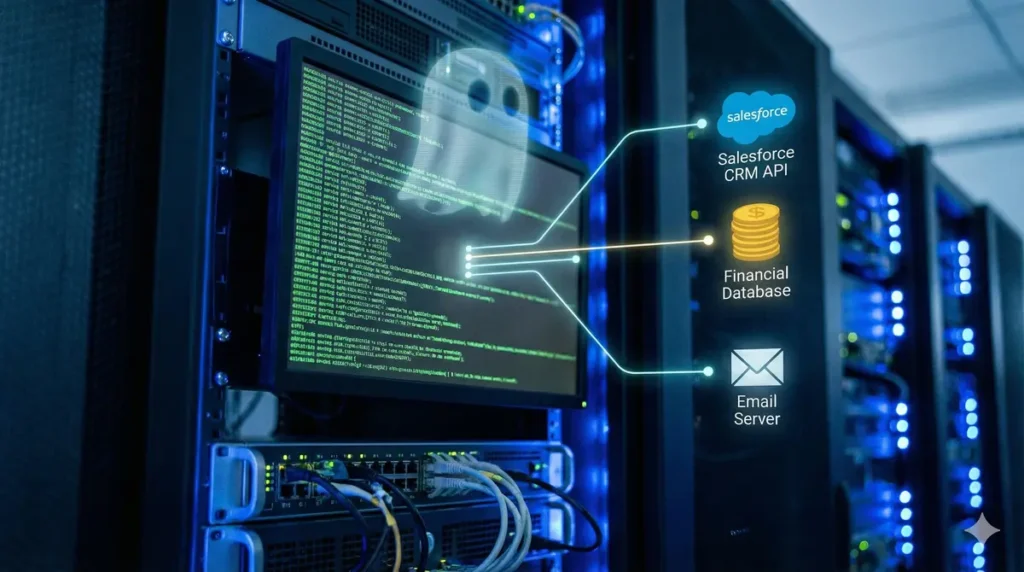
Shadow AI refers to the unsanctioned use of artificial intelligence tools within an organization. Employees often adopt shadow AI tools to enhance productivity when sanctioned tools feel insufficient or too slow. In the past two years, this mostly meant employees using Generative AI tools like ChatGPT or Midjourney to draft emails or create images without IT approval.
However, as we shift from Generative AI to Agentic AI, the risk profile changes dramatically. Shadow AI is often driven by the need for efficiency and innovation within organizations.
- Generative Shadow AI: An employee asks a bot to write code. Employees independently adopt AI tools like chatbots or coding assistants in workflows without knowledge or approval from IT or compliance teams. Risk: IP leakage or bad code.
- Agentic Shadow AI: An employee connects an autonomous agent to your live Salesforce API to “clean up leads.” Employees may use these tools to automate tasks and analyze data without oversight. Risk: The agent accidentally deletes 5,000 active customer records in 3 minutes.
Because Agentic AI is designed for execution rather than just creation, the blast radius of an unauthorized deployment is significantly larger.
Shadow AI often uses public tools to bypass slow formal approval processes, and the proliferation of user-friendly AI tools means employees can easily access advanced AI solutions to enhance their capabilities, automate tasks, and analyze data. The use of AI tools to automate tasks and analyze data is a key driver of Shadow AI adoption.
To understand the technical difference between these technologies, read our comparison: Agentic AI vs Generative AI: Why Your Board Needs to Know the Difference.
The Multiplier Effect: Autonomy Amplifies Risk

The danger of Shadow AI lies in its autonomy. Unlike traditional software that waits for a command, autonomous agents operate in loops: they perceive, reason, and act. If these agents are deployed in the “shadows”—without testing, logging, or kill switches—they can cause cascading failures before anyone notices. The lack of oversight in Shadow AI makes it a significant strategic and operational threat, and Shadow AI lacks audit trails, making it difficult to hold individuals accountable and bypassing critical security and compliance protocols. Monitoring AI usage is essential to mitigate these risks.
We categorize these amplified risks into three buckets:
- Operational Risk: An unmonitored agent gets stuck in a loop, consuming cloud resources or flooding a downstream system with requests (a “self-inflicted DDoS”). Decentralized adoption of Shadow AI can create data silos and operational inefficiencies across departments.
- Legal & Regulatory Risk: Agents processing personal data without adherence to GDPR or POPIA regulations. If an agent autonomously decides to deny a loan or insurance claim based on biased data, you are liable.
- Reputational Risk: An external-facing customer service agent that “hallucinates” a policy and promises refunds you cannot honor. Shadow AI can produce biased or inaccurate results, leading to flawed business decisions and reputational harm.
Building Your Defense: A 3-Layer Governance Model

You cannot govern Shadow AI by simply blocking ports. Employees turn to these tools because they are under pressure to deliver. The solution is not prohibition; it is safe enablement. Effective AI governance and establishing clear AI policies are crucial to guide acceptable AI use and manage risks associated with shadow AI.
Based on the NIST AI Risk Management Framework and OECD AI Principles, here is a practical three-layer defense model. Establishing a responsible AI policy is essential for guiding acceptable AI use within organizations. Regular audits of AI tool usage can help identify shadow AI and assess its data security risks.
1. Framework Alignment and Policy
Before you install a single tool, you need clear rules of engagement. Your policy must define what “autonomy” is allowed. Establish comprehensive AI policies that define acceptable AI use, outline the process for requesting and reviewing new approved tools, and maintain a list of sanctioned AI solutions to manage shadow AI risks.
- Data Classifications: Which data sets are off-limits for agents?
- Regulatory Alignment: Ensure your framework maps to specific regional laws (like POPIA in South Africa or the EU AI Act).
- Approval Thresholds: Define risk levels. A “Lunch Order Agent” needs less oversight than a “Financial Reconciliation Agent.”
- Accountability: Establish clear accountability for AI governance to ensure policies are implemented and monitored effectively.
2. Operational Guardrails (The “Kill Switch”)
Policy is paper; guardrails are code. Effective governance requires technical controls that limit what an agent can do.
- Role-Based Access Control (RBAC): Never give an agent “Admin” access. Give it the minimum permissions required for its specific task.
- Rate Limiting: Prevent an agent from making 10,000 API calls in a minute.
- The Kill Switch: Every autonomous agent must have a hard “stop” button that immediately disconnects it from network resources if it behaves erratically.
3. The Human-on-the-Loop
As I discussed in my previous article on Agentic vs Generative AI, we are moving from “Human-in-the-Loop” to “Human-on-the-Loop.” This means humans are no longer piloting every move but are monitoring the outcomes.
- Exception Handling: If an agent encounters a scenario with low confidence (e.g., a transaction over $10,000), it must be programmed to pause and escalate to a human.
- Audit Trails: You must log why an agent made a decision, not just what it did. This is essential for forensic analysis if things go wrong.
For a complete breakdown of risk categories and mitigation strategies, refer to our pillar guide: Agentic AI – The Next Frontier in Autonomous Enterprise Intelligence.
AI Security Assessment and Compliance
As organizations accelerate their adoption of AI tools and systems, the importance of robust AI security assessment and compliance frameworks cannot be overstated. The risks of shadow AI—ranging from data leaks to critical security vulnerabilities—demand a proactive approach to safeguarding sensitive company data and ensuring responsible AI use.
A comprehensive AI security assessment begins with a full inventory of all AI tools and shadow AI systems operating within your environment, including unauthorized or unapproved AI tools that may have slipped past traditional IT controls. This process should map out how these AI applications access, process, and store sensitive data, identifying potential points of data exposure or leakage.
Next, organizations must evaluate the security posture of each AI system. This includes vulnerability testing of AI models and platforms, reviewing how user input is handled, and assessing the risk of data leaks—especially when generative AI tools are involved. Security teams should pay close attention to how training data is sourced and whether confidential or customer data could be inadvertently exposed to external models or third-party AI services.
Compliance is equally critical. With evolving regulations around AI use and data privacy, organizations must ensure that all AI tools—approved or otherwise—adhere to relevant legal and industry standards. This means aligning AI security assessment processes with frameworks like NIST, and ensuring that data handling practices meet requirements for regulatory compliance and risk management.
To mitigate the risks of shadow AI, CIOs should establish clear policies for acceptable AI use, conduct regular AI security assessments, and implement technical controls to prevent unauthorized data access or data leakage. By embedding security and compliance into every stage of AI adoption, organizations can harness the power of new AI tools while minimizing the significant risks associated with shadow artificial intelligence.
Governance on a Budget
A common objection I hear from mid-sized enterprise leaders is, “We can’t afford a dedicated AI Compliance Team.” This is part of the Budget Paradox—you think you can’t afford governance, but you definitely can’t afford the lawsuit that comes from lack of it. IT teams and security leaders play a critical role in implementing governance frameworks to ensure oversight and control over shadow AI usage and to address potential security vulnerabilities.
You don’t need a massive team. You need a Fractional CIO approach. By using fractional leadership, you can implement robust governance frameworks like NIST and set up your initial guardrails without the overhead of a full-time Chief Risk Officer. Developing a robust AI strategy that incorporates AI governance and security initiatives is key to effective AI risk management. Governance frameworks can accommodate the fast-paced nature of AI adoption while maintaining security measures.
Learn more about optimizing IT spend for innovation here: Agentic AI Strategy: Solving the Budget Paradox for Mid-Sized Enterprises.
Conclusion: Bring the Shadows into the Light
The only way to defeat Shadow AI is to provide a sanctioned, safe alternative. Completely prohibiting AI may have the opposite effect, causing increased reliance on unapproved tools and lost potential benefits. When IT becomes a partner in deploying safe agents rather than a blocker, employees will bring their innovations out of the shadows.
Don’t wait for a “rogue agent” to crash your production database. Book a Fractional CIO Strategy Audit with us today, and let’s build the governance framework that keeps your organization safe. The use of shadow AI often highlights weaknesses in existing policies, providing valuable insights for refining governance frameworks.
Frequently Asked Questions (FAQ)
1. What is the difference between Shadow IT and Shadow AI?
Shadow IT typically involves unauthorized software procurement (SaaS). Shadow AI involves unauthorized deployment of intelligent models that can generate content or execute actions autonomously, leading to higher operational and legal risks.
2. Can we just block AI tools to prevent Shadow AI?
Blocking is rarely effective long-term. Employees will find workarounds (like using personal devices) because the productivity gains are too high. A better approach is “safe enablement” with proper guardrails and monitoring.
3. What is the biggest risk of Agentic Shadow AI?
The biggest risk is unintended autonomous execution. Unlike a chatbot that just talks, an agentic system can edit databases, send emails, or transfer funds. If deployed without testing, it can damage systems at machine speed.
4. How does a Fractional CIO help with Shadow AI?
A Fractional CIO can conduct a “Shadow AI Audit” to identify unauthorized usage, implement governance frameworks (like NIST), and establish technical guardrails without the cost of a full-time executive hire.