IT Strategic: A Boardroom Playbook for Turning Technology into Competitive Advantage
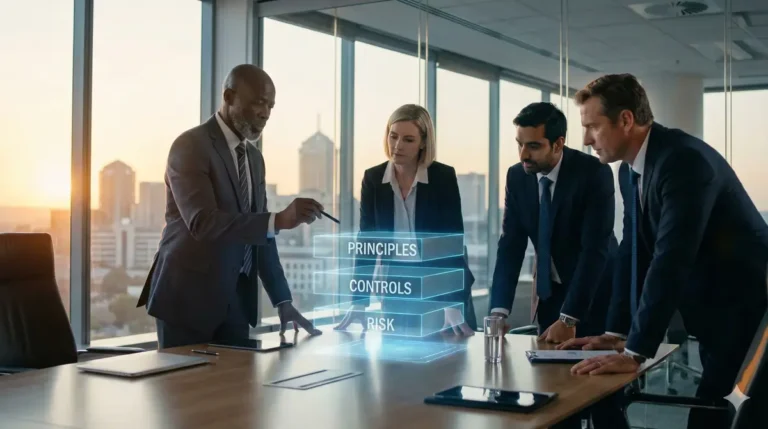
In my decades of experience sitting on both sides of the boardroom table—first as a CIO and now as a strategic consultant—I have seen technology budgets balloon while business value stagnates. The missing link is almost always a lack of coherent IT strategic planning. Too often, technology is treated as a utility to be managed rather than a lever for competitive advantage. This guide is my playbook for closing that gap, drawing on the governance principles of King IV and COBIT to help you build a technology roadmap that your board will actually understand and support.
Key Takeaways
- IT strategy is a board-level business discipline, not a technical exercise. This article is written from the perspective of a former CIO now working as a Fractional CIO, bringing decades of experience translating technology investments into measurable business outcomes.
- An effective IT strategic plan directly targets revenue growth, margin improvement, and risk reduction over a 3–5 year horizon. It’s about future-proofing the enterprise, not just keeping the lights on.
- Formal IT governance frameworks like COBIT and King V provide the safety rails that boards need to oversee technology risk and investment decisions with confidence.
- A functioning IT Steering Committee is the engine that keeps strategy alive between board meetings—without one, even the best strategic plan document gathers dust.
- The distinction between IT management (operations, tickets, uptime) and CIO leadership (digital business models, data leverage, strategic direction) is critical. Many organizations confuse the two, leaving a dangerous strategic gap.
- A Fractional CIO model allows mid-market firms to access board-level strategic leadership without paying for full-time C-suite headcount—typically at 20-40% of the cost.
What Is an IT Strategic Plan – In Business Terms, Not Tech Jargon
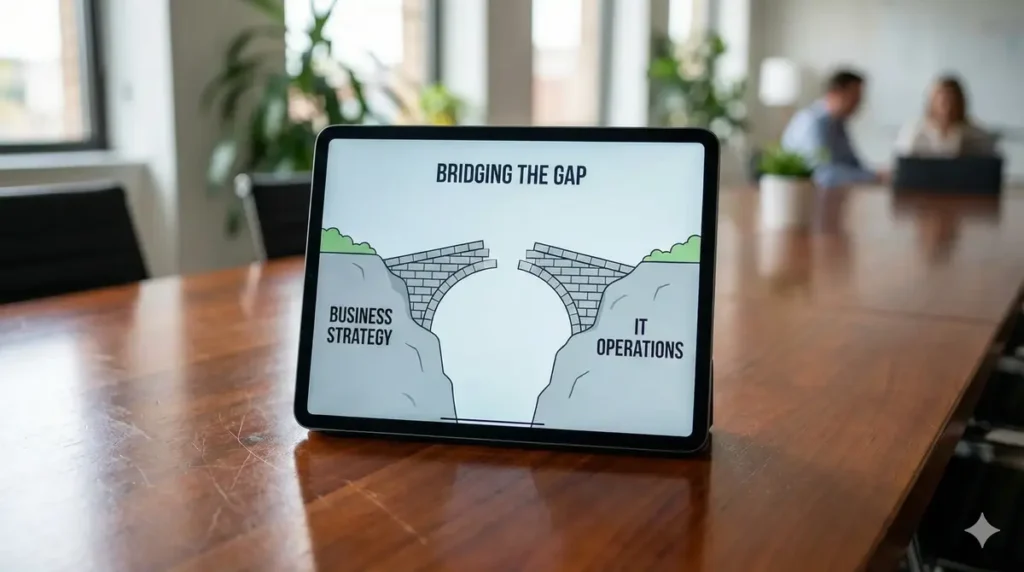
An IT strategic plan is a 3–5 year business roadmap that specifies how technology will enable revenue, cost, and risk targets set by the board. It is not a catalogue of servers, software licenses, and upgrade schedules. It is a strategic document that sits alongside your business plan, market strategy, and financial projections.
The plan should be written in business language and structured similarly to other strategic plans. Think markets, capabilities, risks, and investments—not technical specifications and system requirements. When I walk into a boardroom and the IT strategy reads like a vendor proposal, I know we have work to do.
In practice, the plan links specific business objectives to concrete technology capabilities. For example:
| Business Objective | Technology Capability | Target Timeline |
|---|---|---|
| Grow online revenue from 15% to 35% | E-commerce platform modernization, CRM integration | By 2028 |
| Reduce order-to-cash cycle by 40% | ERP upgrade, workflow automation | By 2026 |
| Achieve zero critical security incidents | Zero-trust architecture, advanced detection | Ongoing |
This strategic plan becomes the reference point for every major IT investment, vendor contract, and technology initiative over its lifespan. It prevents the ad-hoc purchasing decisions that create technical debt and integration nightmares down the road.
A seasoned CIO or Fractional CIO typically owns this document, but it must be endorsed by the CEO and the board to carry real weight. Without executive sponsorship, even the most brilliant IT vision remains an internal IT department exercise that business leaders and other business units quietly ignore.
Why IT Strategic Planning Matters Now More Than Ever
The post-2020 acceleration of cloud adoption and AI has fundamentally changed competitive dynamics. By 2025–2027, most industries will be competing primarily on data, automation, and digital channels. Organizations without a coherent IT strategy are not just falling behind—they are actively accumulating risk and technical debt that will constrain future options.
The consequences of operating without a strategic planning process are tangible and expensive:
- Duplicated systems across business units where sales uses one CRM, marketing uses another, and customer service uses a third
- Uncontrolled SaaS sprawl, with 35% or more of applications unmanaged and unaccounted for in security audits
- Security gaps that leave the organization exposed to breaches, averaging millions in remediation costs
- Projects that overrun because no one agreed on priorities upfront, and resource allocation becomes a political battle
Regulators and governance codes now expect boards to actively oversee technology and information risk. King V in South Africa, various corporate governance codes in Europe and North America, and sector-specific regulations all place responsibility on the board—not the IT department—for technology governance. This is no longer something that can be delegated and forgotten.
I recall a mid-market manufacturing company that pursued ad-hoc systems purchases from 2018–2022. Every business unit head had purchasing authority for “their” technology needs. By 2022, they had 14 different point solutions that couldn’t share data, a cybersecurity posture held together with string and hope, and integration costs that exceeded their entire IT budget. The eventual cleanup took 18 months and cost three times what a proper strategic plan would have required upfront.
When an IT strategy is done well, the upside is substantial. Organizations with mature IT strategies see 28% higher revenue growth according to industry research, faster time-to-market for new products, improved EBITDA through process automation, and reduced cyber and operational risk. High performers who integrate governance achieve 2.5x better digital transformation success rates.
The Building Blocks of a Business-First IT Strategy

These building blocks mirror standard strategy practices but are translated into the language of technology, risk, and information. If you know how to read a business strategy, you can understand an IT strategy—and if you can’t, the strategy was written by technologists for technologists, which defeats the purpose.
IT Vision and Mission
A clear IT vision and mission must be explicitly aligned with the corporate strategy and target operating model for the next 3–5 years. This isn’t about aspirational technology statements like “be cloud-first” or “embrace digital transformation.” It’s about how technology will enable the business to achieve its strategic objectives and business goals.
A good IT vision statement reads something like: “By 2028, our technology capabilities will enable us to serve 50% more customers with 20% fewer staff through automated processes and data-driven decision-making.”
Measurable Strategic Outcomes
Limit yourself to 5–8 measurable strategic outcomes. More than that diffuses focus and makes governance impossible. Examples include:
- Revenue uplift from digital channels (target: 25% of total revenue by 2027)
- Margin improvement through automation (target: 3% EBITDA improvement)
- Risk reduction in cybersecurity posture (target: zero critical incidents)
- Customer experience metrics tied to IT capabilities (target: NPS improvement of 15 points)
These outcomes become the key performance indicators against which all technology initiatives are measured.
Current-State Analysis
Performing a structured current-state analysis is essential before any roadmap can be credible. This includes a SWOT analysis that covers:
- Applications: that legacy ERP from 2009, the multiple unintegrated CRMs, the spreadsheet-based processes masquerading as systems
- Infrastructure: on-premise servers approaching end-of-life, hybrid cloud deployments, network capabilities
- Data: quality, accessibility, governance maturity, and analytics capabilities
- Skills: internal team capabilities, key person dependencies, training gaps
- Vendors: contract status, relationship health, strategic vs. tactical suppliers
- Cyber posture: current controls, known gaps, compliance status
Many organizations discover through this analysis that they’re overspending by 20-30% on redundant legacy systems that deliver little business value. That’s money that could fund strategic initiatives.
Capability Themes
Define key capability themes under which projects will be grouped:
- Data & Analytics
- Customer Digital Experience
- Core Platforms (ERP, CRM, etc.)
- Cybersecurity & Risk
- Collaboration & Remote Work
- Enterprise Architecture
This thematic grouping helps business leaders understand where investments are being directed without needing to evaluate individual technical projects.
From Vision to Roadmap: A Practical Four-Phase Planning Approach
In board practice, a simple four-phase model is easier to govern than highly academic frameworks. This approach can still align with COBIT or similar standards, but it speaks in a language that business and technology leaders can both understand.
Phase 1: Discovery & Alignment
This phase involves structured interviews with the CEO, business unit heads, and key functional leaders (finance, operations, sales, HR) to capture their 2026–2028 priorities and pain points. The goal is to understand what the business needs to accomplish, not what technology the IT teams want to implement.
Key questions include:
- What are your top three business priorities for the next three years?
- What processes or capabilities are constraining your growth?
- What keeps you up at night regarding technology risk?
- How do you envision your function operating differently in 2028?
Phase 2: Options & Prioritization
Translate discovered needs into initiative options. This is where the strategic planning tools come into play—cost/benefit analysis, risk assessments, and prioritization frameworks.
The critical discipline here is prioritizing based on strategic value, not just urgency. The squeaky wheel often gets the grease in IT, but that leads to reactive spending rather than strategic investment. Scenario planning helps evaluate options under different business conditions.
A good prioritization approach uses criteria like:
- Strategic alignment (does this directly support business objectives?)
- Financial impact (revenue, cost, risk reduction)
- Technical feasibility and risk
- Dependencies and sequencing requirements
Phase 3: Roadmap & Funding
Build a 3-year roadmap with specific quarterly milestones, indicative budgets, and resource assumptions. This roadmap must link into annual budgeting and capital allocation cycles—otherwise it remains a wish list with no funding mechanism.
The roadmap should clearly distinguish between:
- Continue initiatives (roughly 60% of current projects that align with the target state)
- Accelerate initiatives (roughly 25% that need more resources to deliver strategic value faster)
- Stop initiatives (roughly 15% that no longer align with business priorities—the hardest decisions)
This discipline alone typically yields 15-20% cost savings by eliminating wasted effort.
Phase 4: Execution & Review
Detail how progress is monitored via KPIs, quarterly steering committee meetings, and formal reviews that allow reprioritization when market or regulatory conditions change. Strategy without execution governance is just an aspiration.
I worked with a €150M services company that developed an excellent IT strategic plan in 2021. Comprehensive analysis, clear priorities, detailed roadmap. By 2023, the plan sat in a drawer. Why? The roadmap was never translated into funding cycles or portfolio governance. Projects stalled because budget requests competed annually with no strategic filter. By year two, the strategy was effectively dead, and they were back to ad-hoc decision-making. The planning process had been thorough, but the execution framework was absent.
IT Governance: The Safety Rails for Your IT Strategy

IT governance is the set of structures and processes that ensure IT decisions are aligned with business goals, appropriately resourced, and risk-aware. Without governance, strategy drifts, budgets overrun, and the organization accumulates technology risk that eventually surfaces at the worst possible time.
Frameworks like COBIT provide a menu of governance practices and controls that boards can selectively adopt. You don’t need to implement all 37 COBIT process categories—that would be bureaucratic overkill for most organizations. Instead, use the framework as a checklist to ensure key governance gaps are addressed.
COBIT 2019 outlines five core principles, including meeting stakeholder needs through dynamic governance systems. Organizations can be scored from 0 (incomplete) to 5 (optimized) on governance maturity. Enterprises at level 3 or higher report 15-25% better alignment of IT spend to business outcomes.
King IV explicitly places responsibility on boards to oversee technology and information risk. This governance code, originating in South Africa but adopted globally, mandates that boards cannot simply delegate technology decisions to management. IT governance must integrate with enterprise risk management—a requirement that has proven critical in sectors like finance, where non-compliance fines averaged $4.5 million per incident in recent regulatory reports.
Formal governance clarifies decision rights:
- Who approves major IT investments above a defined threshold?
- Who owns information risk and reports to the board?
- How is IT performance reported and reviewed?
- What is the escalation path when projects go off-track?
Practical Example: Mapping COBIT to Board Actions
| COBIT Process | Board-Level Action |
|---|---|
| EDM01 – Ensure governance framework setting | Dashboard review at the steering committee |
| EDM02 – Ensure benefits delivery | Review quarterly KPIs on value realization |
| APO12 – Manage risk | Include cyber risk in enterprise risk reporting |
| MEA01 – Monitor performance | Dashboard review at steering committee |
The IT Steering Committee: Engine of Strategic Execution
An IT Steering Committee, chaired by the CEO or a senior executive, is the operational engine that keeps the IT strategic plan alive between quarterly or biannual board meetings. This is where strategic decisions translate into operational reality.
Typical membership includes:
- CIO or Fractional CIO (often as secretary/facilitator)
- CFO (budget authority)
- COO or Head of Operations
- Key business unit leaders with significant technology dependencies
- Occasionally: CISO, Chief Data Officer, or Head of Digital
The committee meets on a fixed cadence—monthly or bi-monthly works well for most organizations. Meetings should:
- Review project status against the roadmap and measure progress
- Approve new strategic initiatives or scope changes
- Reallocate funds when priorities shift
- Resolve cross-functional issues and competing demands
- Escalate major risks or decisions to the board
A retail organization I advised had no steering committee. Sales leadership pushed for a new e-commerce platform. Operations leadership simultaneously pushed for a warehouse management system. Both had legitimate business cases. Both competed for the same IT resources and budget. For 18 months, neither project made meaningful progress because there was no forum to make trade-offs. We established a steering committee, and within two meetings, the CEO made a sequencing decision: warehouse first (to support fulfillment), e-commerce second (but with committed funding for the following year). Both projects were delivered, and the conflict evaporated.
This body is where strategy and execution truly meet. Business priorities become real through project management discipline and resource allocation decisions. A Fractional CIO often serves as the architect and facilitator of these sessions, bringing external perspective and process discipline without internal political baggage.
Management vs. Leadership: Keeping the Lights On vs. Future-Proofing
Many organizations confuse IT management with CIO-level leadership. This confusion leads to underinvestment in strategic capability while overloading operational IT managers with responsibilities they’re not positioned to fulfill.
IT Management is the day-to-day operations:
- Service desk and incident response
- Patching and routine maintenance
- Infrastructure management and uptime metrics
- Vendor administration and contract management
- Support tickets and user issues
- IT operations and system availability
CIO Leadership is shaping how the business will compete using technology in 2–5 years:
- Digital transformation strategy and business models
- Data strategy and analytics capabilities
- Emerging technologies assessment (AI, machine learning, automation)
- Enterprise architecture and platform decisions
- Partnership ecosystems and external environment scanning
- Cyber risk strategy and regulatory positioning
- Drive innovation through technology adoption
Consider a company that only funds “keeping the lights on.” The IT manager is competent—systems are stable, users are supported, tickets are resolved. But by 2027, this company finds itself unable to support AI-powered services or new business models because core platforms and data architecture were never modernized. Competitors who invested in strategic IT can offer personalized customer experiences, predictive analytics, and automated operations. Our hypothetical company is stuck with decade-old systems and fragmented data that can’t power modern applications.
Boards should explicitly ask: “Who is thinking 3–5 years ahead for technology?” If the answer is “our IT manager,” then there is a structural gap that needs addressing. IT managers are typically focused on today’s operations—that’s their job. Strategic leadership requires a different skill set, time allocation, and organizational positioning.
The Chief Technology Officer role, where it exists, may address this gap—but many mid-market organizations conflate the CTO and IT manager roles, leaving strategic questions unaddressed.
Applying IT Strategy to Concrete Business Challenges

Strategy must solve real board-level problems, not theoretical technology scenarios. Here’s how an IT strategic plan addresses common executive concerns:
Digital Revenue Growth
Expanding e-commerce, online portals, or subscription models requires an integrated technology foundation. The strategic plan specifies:
- Platform modernization milestones (e.g., new e-commerce engine by Q3 2026)
- Customer data integration to enable personalization
- Payment and fulfillment system upgrades
- Analytics capabilities to optimize conversion and streamline operations
- Security controls appropriate for digital transaction volumes
Operational Efficiency
Identifying processes ripe for automation delivers measurable business value. The strategy maps:
- Finance close automation (reducing days, freeing analyst time)
- Order-to-cash optimization (improving cash flow, reducing errors)
- Supply chain visibility (real-time inventory, predictive demand)
- Workflow tools, RPA, or upgraded ERPs to support these improvements
Organizations with mature IT strategies achieve 2.5x higher success rates on digital transformation initiatives by connecting these technology initiatives to clear business outcomes.
Cybersecurity and Regulatory Compliance
These are board-level risks that demand multi-year strategic attention. The plan lays out a journey:
- 2024: Basic controls, vulnerability management, and incident response
- 2025: Advanced detection and response capabilities, zero-trust architecture
- 2026: Data governance maturity, privacy compliance
- 2027: Continuous improvement, threat intelligence integration
Zero-trust architectures can reduce breach costs by 50%, making this a strategic investment with quantifiable returns in risk management.
Industry-Specific Example: Healthcare
A regional healthcare provider mapped regulatory changes (data privacy, telehealth regulations) and patient expectations into a stepwise upgrade plan:
- Core EHR system consolidation across acquired practices
- Patient portal modernization for scheduling and records access
- Data governance framework for HIPAA compliance
- Identity management for provider and patient authentication
- Analytics platform for population health and operational efficiency
The strategic plan document connected each technology investment to specific quality, compliance, and business success metrics that the board could track.
Tailoring the Strategy by Industry and Business Model
Although the planning process is consistent, the emphasis shifts by sector:
- Regional retailer by 2026: unified customer view across channels, modern POS integration, loyalty analytics, inventory visibility—all focused on competitive advantage through customer experience
- Manufacturing firm by 2027: IoT for predictive maintenance, supply chain transparency, quality data management, integration with key business partners
- Professional services by 2026: knowledge management, collaboration platforms, project management tools, client portal, data management for insights delivery
Regulatory context must be built into the roadmap from the outset:
- GDPR in the EU
- POPIA in South Africa
- HIPAA in the US healthcare sector
- PCI-DSS for payment processing
Retrofitting compliance is expensive and risky. A seasoned CIO or Fractional CIO translates generic frameworks into these sector-specific roadmaps, considering internal and external factors that shape technology priorities.
The Case for a Fractional CIO: Strategic Leadership Without Full-Time Overhead

The Fractional CIO model provides an experienced former CIO engaged part-time or on a retainer to deliver board-level technology leadership for organizations that do not need or cannot justify a full-time C-suite role.
Cost comparison:
| Option | Annual Cost (2024-2025) | Strategic Capacity |
|---|---|---|
| Full-time CIO | $350K–$500K+ (salary + benefits) | Full-time, single perspective |
| Fractional CIO | $80K–$180K (retainer-based) | Part-time, network of 100+ vendors, diverse experience |
A Fractional CIO typically:
- Leads the creation or refresh of the IT strategic plan
- Sets up governance structures (steering committee, metrics, reporting)
- Mentors internal IT managers to build long-term success capabilities
- Provides unbiased vendor assessments without procurement conflicts
- Brings war-tested experience from multiple industries and scenarios
A €180M revenue manufacturing company engaged me in 2022 after a $10M cloud migration was going off the rails. The internal IT manager was competent operationally but overwhelmed by vendor management, architectural decisions, and stakeholder conflicts. We imposed COBIT-aligned governance, established a cross-functional steering committee with key stakeholders, and restructured the migration in phases. Within 15 months, the project was completed successfully with an 18% margin uplift from the operational efficiencies gained. Total investment in fractional leadership was roughly €150K—a fraction of what was being wasted monthly before intervention.
The goal is to transfer capability. By 2–3 years, the company either has grown enough for a full-time CIO or has embedded governance and strategy disciplines that can be maintained with lighter-touch advisory support. The Fractional CIO model delivers business growth enablement without permanent overhead.
For organizations between €50m and €400m in annual revenue, this model offers access to consulting services and quality expertise while avoiding the $500K+ fully-loaded cost of a permanent executive hire.
Best Practices to Keep Your IT Strategy Alive and Relevant
A strategy document that is not revisited becomes obsolete within 12–18 months, especially given the pace of AI, data, and regulatory change. By 2025, 85% of IT strategies include generative AI components for operational efficiency—if your plan doesn’t address this, it’s already dated.
Establish a fixed annual cycle:
- Mid-year light review: Are we on track? Any major external factors requiring adjustment?
- Year-end substantial refresh: Inform next year’s budget and capital plans, incorporate lessons learned, update the roadmap
Maintain a concise KPI dashboard (8–12 metrics):
- Project delivery (on-time, on-budget percentage)
- Value realization (benefits achieved vs. projected)
- Cyber incidents (severity, response time, root cause resolution)
- System availability (uptime, performance against SLAs)
- User satisfaction (internal customer metrics)
- Strategic initiative progress (milestone completion)
Track these at every steering committee meeting to realize strategic objectives consistently.
Communicate transparently with business leaders:
- Use plain language and visuals, not technical detail
- Show progress, delays, and trade-offs honestly
- Connect technology updates to the overall business objectives they care about
- Avoid IT jargon that creates distance between the IT organization and the business
Commission periodic external reviews:
- Independent health checks validate assumptions
- Spot emerging risks before they become crises
- Recalibrate the roadmap in light of new technologies and competitors
- A Fractional CIO often leads these assessments, providing a fresh perspective
Boards should ask annually: Does our IT strategy still reflect our strategic vision and organizational goals? If the external environment has shifted—new competitors, regulatory changes, technology disruptions—the strategy must adapt.
Conclusion: Moving from “Keeping the Lights On” to Strategic Value
The difference between a company that struggles with IT costs and one that dominates its market with digital tools isn’t usually the software they buy—it is the strategy that guides them. An IT strategic plan gives you the discipline to say “no” to distractions and “yes” to value.
Whether you are looking to adopt King IV governance principles, establish a functional steering committee, or simply get a handle on your software spend, the path starts with a roadmap. You do not need to navigate this alone.
Ready to align your technology with your business goals? At Blue Phakwe Consulting, we specialize in helping organizations build practical, governance-first IT strategies. Contact us today to schedule a discovery call, and let’s turn your IT department into a strategic asset.
Frequently Asked Questions
1. How often should our board review the IT strategic plan?
The board should receive a concise IT strategy update at least twice a year. One session should align with annual budgeting, providing context for capital and operating budget decisions. The second mid-year checkpoint enables reprioritization if market conditions or broader business goals have shifted.
The IT Steering Committee should meet more frequently—monthly or bi-monthly—to handle tactical decisions and escalate only major shifts or risks to the board. This division of labor prevents board meetings from drowning in operational detail while ensuring strategic oversight remains active.
In volatile periods such as major regulatory changes, market disruptions, or significant technology shifts (like the current AI acceleration), boards may temporarily increase the frequency of IT risk and strategy discussions.
2. What time horizon should an IT strategic plan cover?
Most organizations benefit from a rolling 3–5 year horizon: detailed for the next 12–18 months, directional for years 2–5. This matches typical investment horizons for core platforms like ERP, CRM, and data platforms, and aligns with broader corporate strategy cycles.
The plan should be reviewed and lightly refreshed every year so that it remains a living document rather than a static 5-year guess. The mission statement and strategic outcomes should remain relatively stable, while the roadmap and priorities evolve with business needs and the external environment.
3. Do we need formal frameworks like COBIT or King V, or can we be pragmatic?
Boards do not need to adopt every control in COBIT. Instead, use such frameworks as a checklist to ensure key governance gaps are addressed. Select the elements most relevant to your risk profile, industry requirements, and maturity level.
Where codes like King IV apply, boards are expected to demonstrate they have considered and implemented suitable technology and information governance. Auditors and regulators will look for evidence of structured oversight.
The pragmatic approach combines a subset of controls with clear accountability, metrics, and reporting. An experienced CIO or Fractional CIO can interpret the frameworks in business terms, avoiding both bureaucratic overhead and governance gaps that create risk.
4. How do we know if our IT function is too focused on “keeping the lights on”?
Warning signs include:
- Most IT budget is spent on maintenance rather than change initiatives
- No documented 3-year roadmap or strategic plan starts with current projects rather than business objectives
- Strategy discussions dominated by tools and upgrades rather than business outcomes
- IT leaders unable to articulate how current projects support achieve business goals
- No clear answer to “Who is thinking 3-5 years ahead for technology?”
Ask to see a simple mapping of IT initiatives to top-level business objectives. If this cannot be produced quickly, there is likely a strategic gap that deserves attention.
Consider engaging a Fractional CIO for a 60–90 day assessment to clarify the current state and outline a prioritized path toward a more strategic posture.
5. When is the right time to bring in a Fractional CIO?
Common triggers include:
- Rapid growth (organic or via acquisition) creating technology complexity
- Increased regulatory scrutiny requiring governance improvements
- Rising cyber incidents demanding strategic risk management
- A backlog of conflicting IT projects with no clear prioritization
- Preparation for a major ERP replacement, cloud migration, or AI initiative
- Board concerns about technology risk or IT investment effectiveness
Organizations typically between €50m and €400m in annual revenue find a Fractional CIO particularly cost-effective before committing to a permanent CIO hire. At this scale, the company resources required for strategic IT leadership are significant, but may not justify full-time executive headcount.
Earlier engagement is better. Bringing in strategic leadership before a major initiative helps avoid expensive missteps and rework. A seasoned Fractional CIO brings strategic decision-making discipline and war-tested experience that can save multiples of their engagement cost by preventing common pitfalls.
The question isn’t whether you can afford strategic IT leadership—it’s whether you can afford to compete without it.