
Information Technology Governance Framework: A Board‑Level Guide for 2026 and Beyond
In my work advising executives when I worked in the USA and later in South Africa, I have seen the same story play out dozens of times. A company gets hit with a regulatory fine or a nasty audit finding, and the immediate knee-jerk reaction is to “buy” more governance. They download every template, hire consultants to write thick policy binders, and stifle their IT teams in red tape. This is not governance; it is theater. True success comes from selecting a pragmatic information technology governance framework that acts as a safety rail, not a roadblock.
Whether you are navigating the new King V principles or aligning with NIST, this guide shows you how to build a governance model that satisfies the regulator without paralyzing the business.
Key Takeaways
- No single information technology governance framework is sufficient. Use a “mix and match” approach: King V (released Oct 2025) for principles, COBIT 2019 for detailed controls, NIST CSF for cyber risk, and ISO/IEC 38500 for board duties. This blend provides global coverage without bloat.
- Governance vs. Management is the critical distinction. The board’s job is to Direct and Monitor; the CIO’s job is to plan, build, and run. Blurring this line is a primary cause of IT project failure.
- King V is the new efficiency standard. The October 2025 update simplifies the King IV model, cutting compliance overhead by an estimated 20-30% while bringing digital risk explicitly into the boardroom.
- Governance accelerates speed. Frame governance as “safety rails,” not red tape. Organizations with mature, right-sized IT governance see 20% higher IT ROI, 30% fewer data breaches, and faster initiative approval times.
- Embed the framework over 12-18 months. A practical roadmap—starting with a King V-aligned charter and moving to COBIT controls—prevents “audit fatigue” and ensures the governance sticks.
Why Your Board Needs an Information Technology Governance Framework Now
An information technology governance framework is no longer an IT side project. It sits at the center of corporate governance, right alongside financial controls and enterprise risk management. Since 2020, we have watched regulatory pressure intensify across every major jurisdiction. GDPR enforcement has generated over $14 billion in fines. The SEC now expects explicit cyber disclosures. And the average cost of a data breach has climbed to $4.88 million, with global cyber incidents up 75% since 2020. If your board still treats IT governance as something the CIO handles alone, you are carrying risk you cannot afford.
I write this as a seasoned Fractional CIO who has sat in boardrooms across the US, UK, EU, and South Africa. My job is to help risk committees and business leaders cut through the noise and build governance structures that actually work. While your IT strategic plan defines where you are going, your governance framework defines how you get there safely. What I have learned after decades of this work is simple: stop searching for the one best framework. It does not exist. The organizations that succeed combine King V, COBIT 2019, NIST, and ISO 38500 in a deliberate, lightweight way that fits their business strategy and regulatory landscape.
This article will not give you academic theory or technical jargon. We will focus on business value, legal and regulatory requirements, and execution. You will get war stories from companies that crashed because they ignored proper IT governance and from those that accelerated transformation by getting it right. We will cover the difference between governance and management, walk through each major framework, and give you a practical roadmap for 2026-2028 planning cycles.
In the sections ahead, we will start with the critical distinction between governance and management, then move into how to assemble a pragmatic governance stack that serves your organization without drowning it in paperwork.
Governance vs Management: Getting the Board’s Role Crystal Clear

The single most important concept in any IT governance framework is the distinction between governance and management. Governance focuses on direction and oversight. Management focuses on execution and delivery. When boards blur this line, they either micromanage technology choices or abdicate oversight entirely. Both paths lead to failure.
ISO IEC 38500 and COBIT 2019 use the same language here: Governance means Direct and Monitor. Management means Plan, Build, Run. The board sets the destination. The CIO charts the route and drives the vehicle.
What the Board and Its Committees Must Do
- Approve the IT risk appetite as part of the overall enterprise risk management
- Define strategic objectives for technology that align with the overall business strategy
- Demand clear key performance indicators and metrics that connect IT investments to business goals
- Hold management accountable through regular reporting and independent assurance
- Ensure governance processes are embedded in committee charters and terms of reference
What the CIO, CTO, and IT Leadership Must Do
- Design the operating model for IT resources and related technologies
- Select technologies, platforms, and vendors within board-approved risk thresholds
- Staff teams and develop capability maturity model integration approaches for process improvement
- Run IT operations, service management, and change management day-to-day
- Report honestly on progress, risks, and incidents to the governance structure
In my experience, I have seen boards blur this line with devastating consequences. A European industrial company I advised wanted to accelerate cloud migration to support a new digital channel strategy. But the board, concerned about cyber risk after reading about high-profile breaches, insisted on approving every major technology decision. They reviewed vendor contracts, debated architecture diagrams, and questioned storage configurations. What should have taken 12 months stretched to 30. Competitors launched first. The CEO eventually asked me to help reset the relationship between the board and IT management. We established clear decision rights, defined what “material” meant in dollar and risk terms, and got the board out of technical weeds. The next phase was delivered in under nine months.
Any information technology governance framework your organization adopts must embed this separation into charters, RACI charts, and committee terms of reference. If your board cannot answer “what do we approve versus what do we monitor?” you have a governance gap.
The Mix‑and‑Match Strategy: Building a Practical Governance Stack

Adopting one monolithic framework rarely works in practice. COBIT 2019 has over 40 processes and 400 controls. NIST Cybersecurity Framework focuses narrowly on cyber. ISO 38500 gives you principles but not procedures. King V modernizes corporate governance but does not prescribe IT controls. Each framework solves part of the puzzle. None solves all of it.
The practical answer is a deliberate mix. Here is the stack I recommend for multinational organizations operating in the USA and South Africa:
| Layer | Framework | Purpose |
|---|---|---|
| Principles and Outcomes | King V | Board-level direction, ethical leadership, stakeholder value |
| Board Responsibilities | ISO IEC 38500 | Evaluate, Direct, Monitor duties for directors |
| Processes and Controls | COBIT 2019 | Detailed governance and management objectives for IT |
| Cyber Risk | NIST Cybersecurity Framework | Identify, Protect, Detect, Respond, Recover functions |
| Local Compliance | POPIA, GDPR, SEC Rules | Jurisdiction-specific data protection and disclosure |
How to Map Your Documents to the Stack
- Board documents (risk appetite statements, strategy papers, committee charters) should reference King V principles and ISO 38500 duties
- IT policies and procedures should map to COBIT 2019 control objectives for information and related technologies
- Cybersecurity programs should align with NIST CSF functions with maturity scores by business service
- Audit scopes should use COBIT 2019 as the primary reference, with NIST CSF for cyber-specific reviews
Keep the mix lean. I advise against layering more than three or four frameworks unless regulators or industry requirements demand it. Financial services firms may need additional alignment with COSO enterprise risk management or Basel III. Healthcare organizations may layer HIPAA requirements. But most organizations create complexity they cannot sustain when they adopt every popular IT governance framework standard they encounter.
Think of frameworks like ingredients in a recipe. The right combination creates something excellent. Throwing everything in the pantry into the pot creates inedible chaos.
King IV vs King V: Why the 2025 Update Matters Globally

King V, released in October 2025 by the Institute of Directors in South Africa (IoDSA), represents a significant evolution in corporate governance thinking. Where King IV introduced 17 principles and extensive documentation requirements, King V streamlines the model for broader applicability and reduced compliance burden.
Key Changes in King V
- Simplified governance structure with approximately 10 core principles instead of 17
- Outcomes-based approach emphasizing what governance should achieve, not just what it should document
- Explicit technology and information governance responsibilities brought directly into board mandates
- Reduced reporting burden with 20-30% less documentation overhead according to early IoDSA adoption reports
- Stakeholder-inclusive value creation reflecting modern expectations about ESG and digital ethics
Why Global Boards Should Pay Attention
Although King V is rooted in South African law (aligning with the Companies Act and POPIA), its principles translate directly to international contexts. Boards in the US, UK, and EU increasingly recognize that their governance frameworks need modernization. King V offers a template.
Three practical King V concepts every board should consider:
- Technology and information as explicit governance domains — Your board charter should specifically assign responsibility for overseeing technology strategy, cyber risk, and information assets, not just delegate everything to an IT committee
- Integrated reporting on digital risk — Technology risks should appear in the same integrated report as financial, operational, and strategic risks, not in a separate IT appendix
- Ethical leadership in digital transformation — AI adoption, data monetization, and automation decisions require board-level ethical oversight
Global boards can use King V as the “principles layer” of their information technology governance framework, even if detailed controls come from COBIT 2019 and NIST. This gives you a modern, streamlined foundation that reflects 2025 thinking rather than 2015 practices.
Core Frameworks Every Board Should Know

Let us walk through the three frameworks that form the operational core of any effective IT governance approach: COBIT 2019, NIST Cybersecurity Framework, and ISO IEC 38500. Each has a specific role. Each has strengths and limitations. Understanding how they interlock with King V gives you the complete picture.
1. COBIT 2019: The Control Spine of Enterprise IT
COBIT 2019, developed by ISACA (the Information Systems Audit and Control Association), is the most comprehensive governance and management framework for enterprise IT. It translates business goals into specific IT processes and control objectives.
Key characteristics:
- Separates Governance (EDM domain: Evaluate, Direct, Monitor) from Management (APO, BAI, DSS, MEA domains), reinforcing the board and management split
- Contains 40 governance and management objectives covering everything from strategy alignment to incident response
- Includes maturity models for assessing process capability on a 0-5 scale
- Provides direct mapping to regulatory requirements like SOX, GDPR, and Basel III
Where COBIT 2019 lives in your organization:
- The board and risk committee use it to define IT risk appetite and audit scope
- The CIO and IT department use it to design processes and demonstrate regulatory compliance
- Internal audit uses it to plan information systems audit programs and assess control effectiveness
In my experience, mapping projects and IT operations to COBIT 2019 often reveals surprises. A global manufacturer I worked with discovered they had three separate identity management systems, two project management offices with conflicting methodologies, and no clear owner for IT asset management. By rationalizing against COBIT 2019 process areas, we eliminated duplicate systems, clarified accountability, and achieved 12% IT cost optimization within 18 months.
COBIT 2019 is especially valuable in regulated industries where external auditors expect structured evidence of control effectiveness. If your organization faces SOX compliance, banking regulations, or utility sector requirements, COBIT 2019 should be your control spine.
2. NIST Cybersecurity Framework: Your Cyber Risk Playbook
The NIST Cybersecurity Framework, originally released in 2014 by the National Institute of Standards and Technology and updated through subsequent versions, structures cyber risk into five core functions:
| Function | Purpose |
|---|---|
| Identify | Understand your assets, business environment, and risk exposure |
| Protect | Implement safeguards to ensure service delivery |
| Detect | Discover cybersecurity events on time |
| Respond | Take action when incidents occur |
| Recover | Restore capabilities after incidents |
Why boards should care:
- Regulators and cyber insurers across US, UK, and EU increasingly expect NIST CSF alignment or an equivalent international standard
- 92% of US critical infrastructure organizations use NIST CSF as their primary cyber framework
- NIST CSF tiers (Partial, Risk Informed, Repeatable, Adaptive) give boards a clear maturity language for cyber discussions
Board-level application:
Your CISO should provide dashboards showing maturity levels across the five functions for each critical business service. The board does not need to understand technical details of endpoint detection or network segmentation. The board needs to know: Are we at an acceptable maturity level given our risk appetite? Where are we investing to close gaps?
After a 2021 ransomware incident that cost $80 million in losses and remediation, a US retailer I advised used NIST CSF to prioritize investments. We focused on identity management (Protect), backup and recovery testing (Recover), and quarterly incident response tabletop exercises (Respond). The company achieved zero major incidents in 2024 and now saves approximately $12 million annually in reduced insurance premiums and avoided incident costs.
NIST CSF works as the cybersecurity layer under your overall governance framework, integrating with COBIT 2019 processes for a complete picture.
3. ISO/IEC 38500: Board‑Level Duties and Principles
ISO IEC 38500 (2015 edition) is the international standard specifically designed for the corporate governance of IT. Unlike COBIT’s process detail, ISO 38500 speaks directly to directors and senior executives about their duties.
The Evaluate-Direct-Monitor model:
- Evaluate current and future IT use, including plans, proposals, and investments support business goals
- Direct preparation and implementation of policies ensuring IT meets business objectives
- Monitor conformance to policies and performance against plans
The six principles:
- Responsibility — Clear accountability for IT decisions
- Strategy — IT capabilities aligned with business strategy
- Acquisition — Transparent, balanced IT investments
- Performance — IT delivering value to the organization
- Conformance — IT complying with legal and regulatory requirements
- Human Behaviour — IT policies respecting human factors
Practical application:
Boards should embed ISO 38500 language directly into charters and policies. Technology oversight becomes a normal part of board practice rather than a sporadic “IT update” presentation buried at the end of the agenda.
ISO 38500 complements King V by providing more detailed direction on how directors should evaluate technology investments, approve major initiatives, and monitor performance measurement. For organizations subject to GDPR, sector regulations, or multiple jurisdictions, ISO 38500 provides the internationally recognized foundation.
Use ISO 38500 as a checklist during annual board self-assessments. Ask: Did we evaluate IT plans before approving them? Did we direct clear policies? Did we monitor compliance and performance? If the answer is unclear, your governance structure needs work.
Designing a Business‑Focused Information Technology Governance Framework
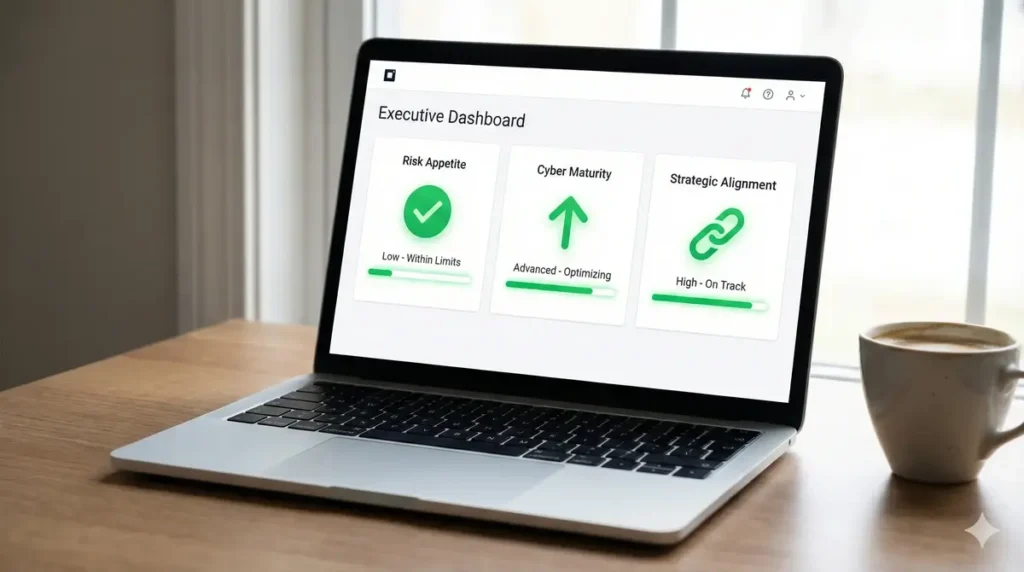
The governance framework itself should be short enough to fit on one page for board consumption. The CIO and risk functions maintain supporting detail, but the board sees a clear, concise model they can actually govern.
1. Main Components
| Component | Description |
|---|---|
| Governance Structure | Committees, roles, reporting lines, meeting cadence |
| Decision Rights | What the board approves vs what management decides (with dollar and risk thresholds) |
| Risk Appetite | Quantified statements about acceptable technology and cyber risk |
| Key Metrics | Performance management indicators tied to strategic objectives |
| Assurance Map | How internal audit, external audit, and management testing cover critical controls |
2. Mapping to Real Business Objectives
Your governance framework should connect to what actually matters for 2026-2028:
- Digital channel growth targets and the IT strategies that support them
- Cloud migration timelines and the risk thresholds for each phase
- M&A integration requirements and technology due diligence standards
- AI adoption decisions and ethical governance processes
- Operational efficiency targets for IT operations and service delivery
Avoid generic IT goals like “improve system availability” without connecting them to customer satisfaction, revenue protection, or operational risk reduction.
3. Integration with Existing Structures
The governance framework involves connecting to enterprise risk management, IT strategic planning, and financial oversight. Create a parallel IT-only bureaucracy and you guarantee turf battles and duplicate reporting.
- Technology risks belong on the enterprise risk register alongside financial and operational risks
- IT investments should flow through the same capital allocation process as other investments
- IT performance metrics should appear in the same executive dashboards as business unit results
4. Keep Documentation Pragmatic
Effective IT management does not require hundreds of pages of procedures. You need:
- Concise policy statements (one page each for major domains)
- A clear RACI that defines who decides, who advises, who is informed
- A small set of board-level dashboards refreshed quarterly
- Exception and escalation processes for when things go wrong
If your governance documentation fills multiple binders, you have created compliance theater, not governance that works.
From Red Tape to Safety Rails: Governance as a Business Accelerator
Here is the mindset shift that separates successful organizations from those drowning in bureaucracy: governance is not red tape. Governance is safety rails that let the business move faster without crashing.
Think about a highway. The guardrails do not slow you down. They let you drive at speed with confidence. Remove them, and drivers slow to a crawl out of fear—or crash spectacularly. The same applies to technology investments, digital transformation, and AI adoption.
In my experience, companies with strong but lean governance consistently outperform those with either no governance or excessive governance. A financial services firm I advised wanted to launch a new digital product to compete with fintech challengers. Previous product launches had taken 18-24 months because every decision escalated to committees that met monthly, risk assessments sat in queues for weeks, and nobody had pre-approved technical standards.
We redesigned their governance approach. We defined clear decision rights with dollar thresholds. We pre-approved a set of cloud platforms, security tools, and development frameworks. We created fast-track exception processes for urgent business needs. We established key performance indicators that tracked speed-to-market alongside risk metrics.
Result: The next product launched in under six months. No major incidents. No regulatory findings. The board had visibility without being in the weeds. The CIO had authority within clear boundaries. Everyone moved faster because they knew the rules.
1. How Governance Mechanisms Enable Speed
- Pre-approved technical standards eliminate weeks of vendor evaluation for routine decisions
- Defined risk thresholds let project managers make decisions without escalation for lower-risk items
- Clear exception processes give teams a path forward when they need to move outside standard boundaries
- Regular reporting cadence builds trust between board and management, leading to faster approvals
2. The Design Test
Any information technology governance framework design workshop should ask this question for every proposed control, committee, or report: How will this help us move faster safely?
If the answer is unclear, challenge whether you need it.
Practical Roadmap: Implementing or Refreshing Your Framework in 12–18 Months
Designing a governance framework on paper is easy. Making it work in practice takes deliberate effort over 12-18 months. Here is the roadmap I use with clients.
Phase 1: Assess (Months 1-3)
Understand your current state before redesigning anything.
Executive outputs:
- Gap analysis comparing current governance to King V, ISO 38500, COBIT 2019, and NIST CSF
- Incident and audit finding review covering the past three years
- Stakeholder interviews with board members, executives, and key IT leaders
Phase 2: Design (Months 3-6)
Define the target governance model aligned to your business strategy and risk appetite.
Executive outputs:
- Board-approved IT risk appetite statement
- Draft governance structure with committee mandates and decision rights
- Framework selection rationale (the “why” behind your mix)
Phase 3: Align (Months 6-9)
Map your chosen frameworks to organizational structures and existing processes.
Executive outputs:
- Mapping document showing how board charters reference King V and ISO 38500
- IT process alignment to COBIT 2019 control objectives
- NIST CSF maturity baseline for critical services
Phase 4: Implement (Months 9-14)
Roll out policies, update charters, deploy dashboards, and train stakeholders.
Executive outputs:
- Updated committee charters and terms of reference
- Approved policy documents for major governance domains
- Board-level dashboard with key metrics and risk indicators
- Training completed for board members, executives, and IT leadership
Phase 5: Review (Months 14-18)
Verify the framework works in practice. Adjust based on lessons learned.
Executive outputs:
- Internal audit assessment against the new framework
- Lessons learned report with improvement recommendations
- External assurance report on critical services and high-impact risks
Sponsorship and Oversight
Appoint a senior executive sponsor—typically the CFO or CRO in partnership with the CIO. Use the risk committee as the primary oversight forum with clear reporting lines to the full board.
Schedule a formal external review or internal audit against the new framework within 12 months of implementation. This verifies that governance works in practice, not just on paper.
Common Pitfalls and How Boards Can Avoid Them
Most failed governance initiatives do not suffer from lack of frameworks. They suffer from over-complexity, unclear accountability, and poor follow-through. Here are the pitfalls I see repeatedly.
The Usual Suspects
| Pitfall | Why it Happens | Consequence |
|---|---|---|
| Adopting too many frameworks | Every consultant brings their favorite; nobody prunes | Audit fatigue, confused accountability |
| Treating governance as an IT project | The Board cannot see the full risk picture | Governance disconnected from strategy |
| Failing to define decision rights | Everyone approves everything; nothing moves | Slow decisions, frustrated teams |
| Ignoring culture and incentives | The board cannot see the full risk picture | Paper compliance, real risk |
| Not integrating with ERM | IT risks live in a separate universe | The Board cannot see the full risk picture |
In my experience, I have seen well-intentioned organizations layer COBIT, Information Technology Infrastructure Library, multiple ISO standards, and proprietary vendor frameworks without retiring anything old. One financial institution had governance committees meeting 47 times per quarter across different frameworks. The IT department spent more time preparing committee packs than delivering projects. We consolidated to three committees, unified reporting against a single COBIT-based structure, and freed 30% of senior IT management time for actual work.
Countermeasures That Work
- Keep the framework small enough that executives can explain it without slides
- Assign clear owners for each governance element with accountability in performance scorecards
- Ensure the board periodically challenges complexity (“Do we still need this committee? This report?”)
- Tie governance measures to executive scorecards so there are consequences for non-compliance
- Conduct annual “governance debt” reviews to remove obsolete committees, metrics, and reports
Every control you add should pass the test: Does this reduce risk more than it slows us down? If not, do not add it.
Conclusion: Turning Governance into a Strategic Advantage
An effective information technology governance framework is not about checking boxes for auditors; it is about creating the conditions for business success in a digital world. When the board sets the direction and management builds the controls, you create an environment where innovation can happen safely.
The organizations that act now to right-size their governance—balancing King V principles with COBIT controls—will outpace those that hesitate. Governance is not a burden. It is a competitive advantage waiting to be claimed.
Does Your IT Governance Satisfy the Board?
The organizations that act now will outpace those that hesitate. Governance is not a burden. It is a competitive advantage waiting to be claimed.
Frequently Asked Questions: Information Technology Governance Framework for Boards
These questions address issues often raised in board and risk committee sessions that deserve additional clarity beyond the main discussion.
1. How often should the board review our Information Technology Governance Framework?
Boards should conduct a formal review at least annually, typically aligned with the enterprise risk management refresh and strategic planning cycle. Additionally, trigger a review after any major technology event: a significant breach, large acquisition, major regulatory change, or strategic shift into new digital markets.
Request a concise “what changed since last year” summary from management covering regulatory developments, threat landscape shifts, and business context changes. This keeps the review focused and actionable rather than a repetitive exercise.
2. Is a formal framework necessary for mid‑sized companies, or only for large enterprises?
Mid-sized organizations, especially those handling personal data or operating in regulated sectors, now face clear expectations from customers, insurers, and regulators to demonstrate structured governance. A breach at a 500-person company creates the same reputational damage and regulatory exposure as one at a 50,000-person company.
The difference is scale, not substance. Smaller firms use the same frameworks (King V principles, ISO 38500, COBIT 2019, NIST CSF) in a lighter form. Focus on the top 10-15 controls that address your highest-impact risks and build a simple governance structure with quarterly oversight. Right-sized governance does not require large teams or excessive bureaucracy.
3. How do these frameworks interact with our existing Enterprise Risk Management (ERM) approach?
The IT governance framework should be an extension of ERM, not a separate universe. Technology and cyber risks belong on the same risk register as financial, operational, and strategic risks. They should use the same risk language, the same escalation thresholds, and the same reporting cadence.
Map COBIT and NIST risks to existing ERM categories. Ensure top IT risks have clear owners, mitigation plans, and board-level reporting. The CRO and CIO should jointly present an integrated view so the board sees trade-offs and dependencies across all major risk areas in one conversation.
4. What is the minimum set of metrics the board should see on IT and cyber governance?
Aim for 6-10 high-level indicators that connect to business outcomes:
- Critical system availability against SLA targets
- Major incident counts and mean time to resolve
- Progress on remediation of high-risk audit findings
- Cyber maturity scores by NIST function for critical services
- IT spend versus plan on strategic initiatives
- Key project milestone delivery against commitments
- Vendor risk exposure for critical third parties
Metrics must tie to customer impact, revenue protection, and regulatory compliance—not purely technical performance numbers. Use a traffic-light or simple scoring format that supports clear board decisions rather than detailed operational dashboards that obscure the key messages
5. How should we involve external auditors and regulators in our governance journey?
External auditors can validate whether your chosen mix of frameworks is being applied consistently and effectively, but the board must own the design choices. Do not outsource governance architecture to auditors—they assess, they do not design.
Proactively engage key regulators where appropriate, demonstrating how your framework aligns with their expectations for cyber resilience, data protection, and operational continuity. This builds credibility before issues arise rather than scrambling to explain your approach after an incident.
Request periodic, independent assurance reports focused on critical services and high-impact risks. Attempting to test every control equally wastes resources and produces meaningless assurance. Focus external attention where it matters most.