Agentic AI vs Generative AI: Why Your Board Needs to Know the Difference
As a former Group CIO, I have sat in enough executive meetings to recognize when a technology conversation is stuck in the past. For the last two years, your Board has likely been asking about “Generative AI” – tools like ChatGPT that can draft emails, summarize documents, and create content. But as we move into the 2026 executive agenda, the conversation must shift to agentic AI vs generative AI, emphasizing the comparison between these two approaches.
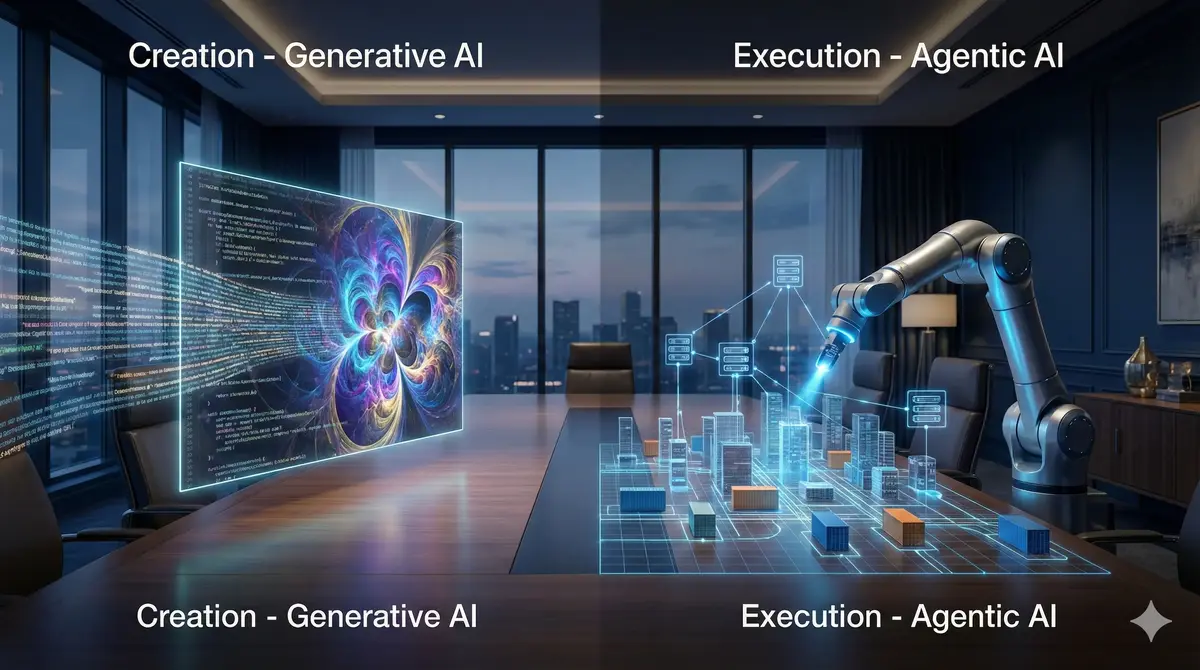
The defining battleground for enterprise efficiency is no longer about creation; it is about execution. This is the core distinction of Agentic AI vs Generative AI, and understanding it is critical for Directors who want to drive genuine operational transformation rather than just digital novelty. The key difference lies in how agentic AI autonomously manages workflows and drives operational efficiency, while generative AI focuses on collaboration and augmenting human capabilities.
Introduction to AI Technology
Artificial intelligence (AI) is rapidly transforming how organizations approach complex tasks, from automating routine processes to enabling entirely new ways of working. As AI technology evolves, two distinct paradigms have emerged at the forefront: Agentic AI and Generative AI. While both fall under the broad umbrella of artificial intelligence, they serve different purposes and offer unique advantages.
Agentic AI and Generative AI are reshaping industries by tackling challenges that once required significant human effort, but understanding the key differences between them is essential for leaders seeking to harness their full potential. In this article, we’ll explore how these two forms of AI technology are driving innovation, streamlining operations, and redefining what’s possible in the modern enterprise.
Definition of Agentic AI
Agentic AI refers to a class of artificial intelligence systems designed to act independently, making decisions and executing actions to achieve specific goals with minimal human intervention. Unlike traditional AI, which typically focuses on analyzing data or recognizing patterns, agentic AI systems are built to manage multi-step tasks, adapt to changing circumstances, and adjust their strategies in real time.
By leveraging large language models (LLMs) and other advanced technologies, agentic AI represents a significant leap forward—enabling machines to perceive their environment, reason about the best course of action, and carry out tasks from start to finish. This autonomy allows agentic AI to orchestrate complex workflows, solve problems proactively, and deliver outcomes with far less need for constant human oversight.
Definition of Generative AI
Generative AI is a type of artificial intelligence that specializes in creating new content—whether it’s text, images, code, or even music. Powered by large language models (LLMs) and trained on vast datasets, generative AI tools like ChatGPT and DALL-E can produce outputs that closely mimic human creativity.
The primary function of a generative AI model is to generate content in response to human prompts, making it a powerful tool for content creation, brainstorming, and ideation. However, generative AI is inherently reactive: it requires human input to initiate tasks and relies on human oversight to ensure quality and relevance.
While generative AI excels at producing high-quality, contextually appropriate content, it does not possess the autonomy or decision-making capabilities of agentic AI and cannot independently execute multi-step processes or adapt to new information without explicit direction.
The Core Distinction: The Artist vs The Employee

To explain Agentic AI vs Generative AI to a non-technical Board, you must move beyond technical jargon and focus on capability.
Generative AI is like a talented, hyper-fast assistant who sits at a keyboard waiting for instructions. It excels at creation. Generative AI creates content based on prompts, but it has low autonomy and depends entirely on user input to drive interactions. If you ask it to “write a marketing email,” it generates text based on patterns it learned during training. However, once it generates that text, it stops. It cannot open your email client, attach a file, or hit “send” unless a human explicitly bridges that gap. This process requires constant human input to guide each step.
Agentic AI, by contrast, is designed for autonomous execution. It mimics human decision-making to solve problems in real-time. With workflow automation capabilities, agentic AI can manage complex, multi-step processes across systems with minimal human input, enabling full workflow automation. It doesn’t just “write the email”; it perceives the need for the email, reasons about the best time to send it, uses tools (like your CRM or Outlook API) to execute the task, and learns from the result.
Agentic AI operates with minimal human oversight and does not require constant human intervention, highlighting its ability to act independently and adaptively.
In short: Generative AI talks about work. Agentic AI does the work. Unlike generative AI, which is reactive and content-focused, agentic AI is proactive, autonomous, and capable of independently solving complex problems.
Agentic AI can also automate internal workflows, making tasks easier for human employees without the need for their physical intervention.
Comparison: From Chatbot to Digital Worker

| Feature | Generative AI (The Assistant) | Agentic AI (The Worker) |
|---|---|---|
| Primary Function | Content Creation (Text, Images, Code) using gen ai tools | Task Execution & Orchestration by ai agent, managing the entire process |
| Trigger | Reacts to human prompts | Proactive; monitors signals/goals |
| Scope | Single session; limited memory | Long-term goals; persistent memory; can manage the entire customer journey, accessing data across systems to resolve issues autonomously |
| Tools | Cannot access external tools independently | Connects to ERP, CRM, APIs autonomously |
| Autonomy/Agent Type | gen ai tools | ai agent |
Virtual assistants are a common example of agentic AI applications, operating autonomously to handle tasks such as customer support, sales outreach, and complex decision-making.
For a deeper technical definition of these autonomous systems, refer to our Cornerstone Guide: Agentic AI – The Next Frontier in Autonomous Enterprise Intelligence.
Use Cases for Agentic AI
Agentic AI is unlocking new possibilities across a range of industries by enabling machines to act independently and manage complex workflows.
In financial risk management, agentic AI can analyze real-time data, make trading decisions, and dynamically adjust strategies in response to market fluctuations—all with minimal human intervention.
In software development, agentic AI systems can automate repetitive tasks such as debugging, code generation, and testing, streamlining the entire development lifecycle.
Beyond these areas, agentic AI-powered agents are increasingly used for automated workflow management, coordinating multiple tools and systems to achieve business objectives efficiently.
By leveraging machine learning and robotic process automation, agentic AI can handle complex, multi-step processes, freeing up human talent to focus on strategic thinking and high-value initiatives.
Use Cases for Generative AI
Generative AI has become a cornerstone of modern content creation, offering powerful tools for generating text, images, and even video with remarkable speed and quality. Gen AI models are widely used to draft marketing copy, create visual assets, and assist with code generation, helping organizations streamline creative workflows and augment human productivity.
In addition to content creation, generative AI excels at data augmentation, producing synthetic datasets to improve the training and performance of other AI models. While generative AI tools are highly effective in these domains, they require human input to initiate tasks and ongoing oversight to ensure outputs meet organizational standards.
Unlike agentic AI, generative AI models are not designed for autonomous decision-making or managing complex, multi-step tasks, but they remain invaluable for scenarios where creativity, rapid prototyping, and content generation are key.
The “So What?” for the Board
Why does this distinction matter for governance and strategy? Because Agentic AI vs Generative AI represents a fundamental shift in risk and operating models.
The key difference lies in how agentic AI can autonomously make decisions and take actions, while generative AI focuses on creating content based on input data. This distinction impacts their capabilities, decision-making processes, and the level of autonomous actions they can perform.
Both agentic AI and generative AI can pose security and privacy risks due to their capabilities to access and process data. As a result, both require careful governance frameworks to ensure ethical use and mitigate risks.
For board-level decision-making, the importance of relevant data cannot be overstated—AI systems must extract and utilize pertinent information to support accurate and efficient outcomes.
The key benefits of understanding this distinction include improved detection capabilities, enhanced operational efficiency, and stronger overall security team performance, all of which are critical for effective governance and strategic planning.
1. From “Human-in-the-Loop” to “Human-on-the-Loop”
With Generative AI, a human is almost always the “pilot,” reviewing output before it is used. Agentic AI operates with a higher degree of autonomy. It can set sub-goals and plan execution sequences without step-by-step instructions. Agentic AI systems use feedback loops to self-evaluate their performance, refine their actions, and adapt based on output and internal metrics, enabling continuous improvement and self-correction.
Agentic AI can also maintain persistent goals across multiple interactions, breaking complex objectives into executable sub-tasks.
This requires a shift in governance. You are no longer approving a document; you are approving a process and the guardrails within which an agent operates. This moves oversight from “checking work” to “auditing outcomes.”
2. The Shift to Proactivity

Generative AI is reactive—it waits for a user to ask a question. Agentic systems are proactive. An agentic system monitoring your supply chain doesn’t wait for you to ask, “Where is the shipment?” It notices a delay in real-time, checks inventory levels, and automatically reschedules a delivery to prevent a stockout. This is an example of workflow automation, where agentic AI autonomously coordinates and adjusts complex, multi-step processes across systems. Agentic AI can oversee end-to-end business processes without human oversight, such as dynamically rerouting deliveries based on live traffic data.
This proactivity transforms IT from a cost center into a strategic value driver, catching problems before they escalate.
The “Brain” and the “Hands”
To understand how Agentic AI achieves this, think of the “Six-Stage Enterprise Loop”. While Generative AI provides the “Reasoning” (the brain that understands language), Agentic AI adds the “Perception” (gathering data from sensors/APIs) and “Action” (invoking tools). Agentic AI works by structuring workflows that involve multiple AI agents and humans collaborating to achieve complex goals, orchestrating, delegating, and managing tasks across a multi-agent system.
- Perception: It reads live data from your Salesforce or SAP instance. At this stage, an AI agent autonomously gathers and interprets information from various sources, preparing it for further analysis.
- Reasoning: It uses an LLM to decide what that data means. Generative AI models leverage deep learning to analyze training data, identify patterns learned from vast datasets, and generate coherent outputs. These models do not simply analyze existing data; instead, they create new content based on the patterns found in their training data.
- Action: It triggers a workflow, updates a database, or alerts a human. The AI agent can manage the entire process, overseeing complex workflows from start to finish, integrating tasks and decision points without human intervention.
- Learning: It refines its approach based on whether the outcome was successful.
Generative AI relies on deep learning models to identify patterns in large datasets and generate original content such as text, images, or code. It excels at creating new content based on the patterns learned from its training data, rather than working directly with existing data. Generative tools are widely used for content creation, automation, security, and incident response, streamlining workflows and enhancing operational efficiency.
Agentic AI can autonomously identify what needs testing, create comprehensive test strategies, execute tests across multiple environments, analyze results, and even self-heal when applications change. It can manage entire test lifecycles from test generation through execution and maintenance, adapting to application changes without human intervention.
This architecture allows it to orchestrate complex workflows across multiple systems—your CRM, ERP, and HRIS—rather than remaining trapped in a chat window.
Strategic Implications: Budget and Sourcing

Understanding the difference between Agentic AI vs Generative AI also changes how you budget. Generative AI is often a software subscription (SaaS). Agentic AI is an operational capability that requires integration, governance, and a new approach to resourcing. The key benefits of agentic AI for budgeting and sourcing include improved operational efficiency, cost-effectiveness, and enhanced resource allocation.
Current trends favor a hybrid approach, where Agentic AI acts as a ‘manager’ and Generative AI serves as a ‘creator’ in applications. Advances in generative AI directly expand the capabilities of agentic AI, enabling more sophisticated and effective solutions.
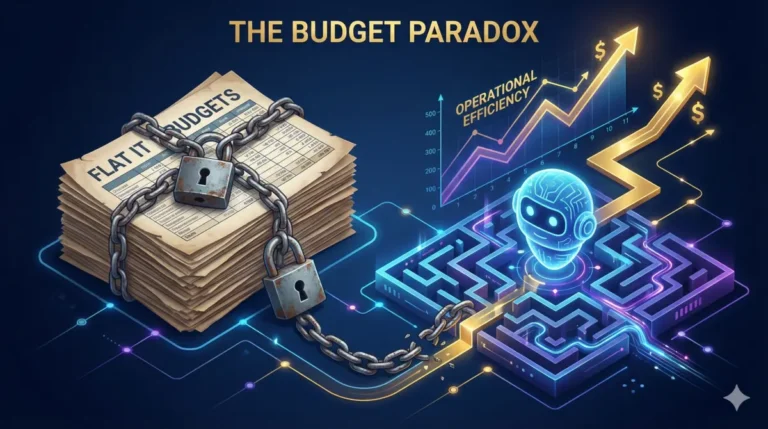
Many Boards fear that this complexity means spiraling costs. However, as I discussed in my previous analysis on the Budget Paradox, you do not need a massive R&D team to build this. By using a Fractional CIO model and smart global sourcing, mid-sized enterprises can deploy these “digital workers” cost-effectively.
Read more on how to fund this transition. See our article: Agentic AI Strategy: Solving the Budget Paradox for Mid-Sized Enterprises.
Conclusion: Ask the Right Questions

The next time your Board discusses AI, move the conversation past “chatbots.” Ask:
- “Are we investing in tools that just create content, or systems that execute work?”
- “Do we have the governance frameworks to handle autonomous agents?”
- “Is our data ready to support decision-making, not just summarization?”
If you need help answering these questions or explaining the strategic value of Agentic AI vs Generative AI to your stakeholders, book a Fractional CIO Strategy Audit with us today. Let’s turn your AI strategy from a hype cycle into a competitive advantage.
Frequently Asked Questions
1. What is the main difference between agentic AI and generative AI?
The main difference lies in their core functions and autonomy. Generative AI specializes in creating new content—such as text, images, or code – in response to human prompts and is reactive by nature. Agentic AI, on the other hand, is proactive and autonomous, capable of independently making decisions, managing complex multi-step workflows, and executing tasks with minimal human intervention.
2. Can agentic AI and generative AI work together?
Yes, agentic AI and generative AI often work collaboratively. Agentic AI systems may use generative AI models as tools within their workflows to create content like emails or reports as part of a larger goal. In this relationship, generative AI acts as the creative assistant, while agentic AI acts as the executor or “digital worker” managing the entire process.
3. What are some common use cases for agentic AI?
Agentic AI is widely used in industries requiring autonomous decision-making and workflow automation. Common use cases include financial risk management, where it analyzes real-time data and adjusts strategies; software development, automating debugging and testing; supply chain optimization; cybersecurity with real-time threat response; and healthcare monitoring through smart devices.
4. What risks and ethical considerations are associated with agentic AI and generative AI?
Both technologies pose security and privacy risks due to their data access and processing capabilities. Generative AI can produce misinformation or biased content and requires human oversight to ensure accuracy. Agentic AI’s autonomous decision-making raises accountability challenges, especially when mistakes occur. Careful governance frameworks are essential to mitigate these risks and ensure ethical use.
5. How should organizations approach budgeting and governance for agentic AI vs generative AI?
Generative AI is often delivered as software-as-a-service (SaaS) and requires less integration effort, focusing on content creation. Agentic AI is an operational capability that demands integration across systems, governance frameworks for autonomous workflows, and ongoing management. Organizations should align their investments with strategic objectives, balancing creative augmentation with autonomous execution capabilities.